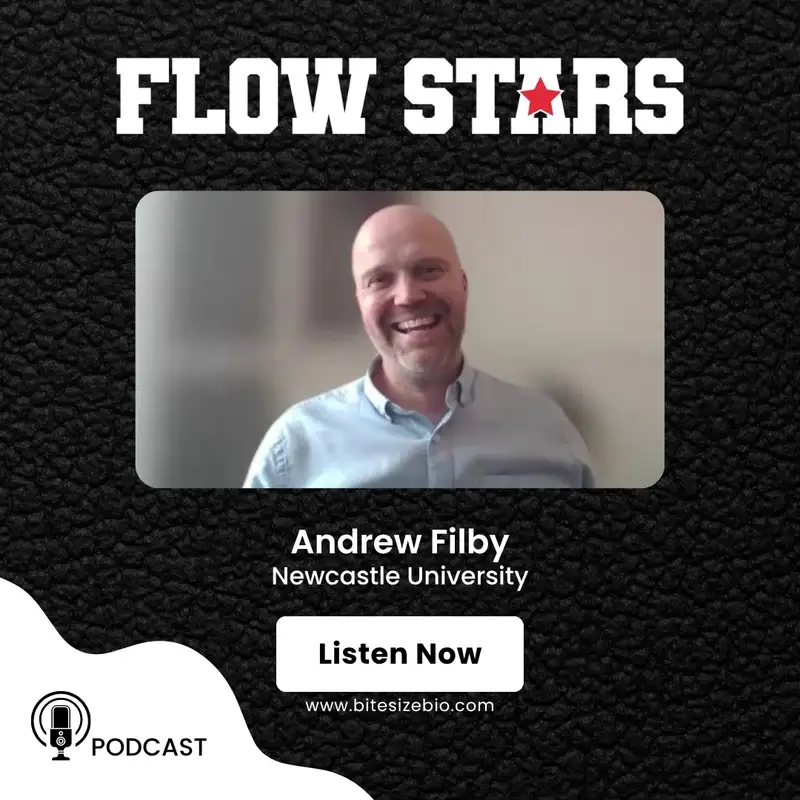

Andrew Filby
Welcome to Flow Stars candid conversations between doctor Peter O'Toole and the big hitters of flow cytometry brought to you by Beckman Coulter at Bite Size Bio.
Peter O'Toole:Today on Flow Stars, I'm joined by my good friend, Filby, and he reflects on the career moments that led him into core facilities.
Andrew Filby:And then I sort of felt that maybe I needed to do something different. Probably lost a bit of faith in research, let's say. I think I was I would say to people that I saw people that were far, far smarter than me not succeeding in research.
Peter O'Toole:And Andrew discusses why technical specialists should be properly recognized.
Andrew Filby:When you think about technical roles, you wanna you wanna keep specialty, you wanna reward specialty, and you wanna invest in it as well because it gives you a competitive edge potential.
Peter O'Toole:And how a few donuts helped him choose his degree in biochemistry.
Andrew Filby:I wish there was a a better grand plan there, but not really. Just donuts, nice nice lecturer, and slight mistake about what was organic chemistry was
Peter O'Toole:biochemistry. All this coming up in today's episode of Flow Stars. Hi. Welcome to Flow Stars. I'm Peter O'Toole from the University of York.
Peter O'Toole:Today, I'm joined by Andrew Filby from the University of Newcastle. Andy, how are you today?
Andrew Filby:Yeah. I'm good, Pete. Nice to see you.
Peter O'Toole:Yeah. Likewise. Andy, when did we first meet?
Andrew Filby:That's a good question. It feels like I've known you forever. It must have been when I was working for, I think, the company that was looking after the image stream system in The UK. I think it was prior even to when I worked for Derek at Cancer Research. So maybe sort of mid two thousands, possibly.
Peter O'Toole:Yeah. It was it was definitely yeah. So it was image stream before cancer research. You could before It was. Yeah.
Peter O'Toole:So it's definitely your image stream days. God. If you've known me for that long, I should call you dad.
Andrew Filby:Well, that that would be strange, but yes.
Peter O'Toole:So you let yourself into that one, Andy.
Andrew Filby:I have. So
Peter O'Toole:why why don't we start? Where did you do your first degree?
Andrew Filby:Yes. I did my first degree in Huddersfield University, and I did a biochemistry degree. Ah, proper degree. Enjoyable.
Peter O'Toole:Yeah. Proper degree. And then PhD?
Andrew Filby:I did my PhD at the what was called the National Institute for Medical Research or the NIMR, which is based up in Mill Hill in North London, and I don't believe that's around anymore. I think it's also become part of the Crick Institute. Yeah. So, yeah, it's great great place to work, though. Really great.
Peter O'Toole:Oh, I've got a good question about that in a well, actually, I'm gonna ask that. So you were in Mill Hill?
Andrew Filby:Yeah.
Peter O'Toole:And then later on, you went to ICR, but it was at Lincoln Fields in in Field. I can never We
Andrew Filby:Can Fields. Yeah. Lincoln Fields. Yeah.
Peter O'Toole:How did the count between those two places compare?
Andrew Filby:Ultimately, pretty similar. They were both obviously dedicated research So there was quite a lot of collaboration and, you know, camaraderie and, you know, just just a really dynamic both of them very dynamic places to work. I think Mill Hill had a very, you know, relaxed quite a relaxed attitude to everything, but, obviously, really high performing. Whereas I'd say LinkedIn Fields was similar, but maybe slightly more kind of structured in how it was set up. But really similar.
Andrew Filby:You know, you knew who everyone was. You know, you could walk down the corridor if you run out of an antibody or a reagent and knock on the door and say, can I can I get some? And, you know, I'll pay you back. And sometimes you pay them back, sometimes you didn't. So it was yeah.
Peter O'Toole:It was really good. Good places to work. Especially when you didn't pay them back. I'm sure it was good. It was great.
Peter O'Toole:Yeah. Yeah. So It's just interesting because, obviously, those two mashed together to make the crick that that you just how that cultural shifts would have happened. So from LIMR, then what happened?
Andrew Filby:Yes. I took a couple of years. So I I did my PhD there. I think it took about four years to complete it. Then I did a short postdoc, and then I sort of felt that maybe I needed to do something different.
Andrew Filby:I think I probably lost a bit of faith in research, let's say. I think I was I would say to people that I saw people that were far, far smarter than me, not succeeding in research. And then maybe the flip side, there were a few, not many, few people who maybe were a little bit different in their attitude to me, and they did quite well sometimes. Maybe that maybe that was a secret. I don't know.
Andrew Filby:But I decided to leave research and go work in commercial science for a couple years. So my first gig was with I'm trying to think what they called. They were Fisher Scientific, they were called in those days, so part of the Thermo Fisher Group. And I ended up becoming an application specialist for a year covering Cambridge East Anglia area, which was great. It was it was great.
Andrew Filby:But I think sometimes it was a little frustrating because it was a bit like being an expert in flat screen TVs, but working for Argos rather than the Sony Center. So I think a little bit of the specialty was wasted a little bit. But got some great skills there. You know, I learned about, you know, selling and profit margins, prospects. Yeah.
Andrew Filby:That kind of world, which actually you know, I'm sure we'll get to that later. It's it's been really, really important in what I ended up doing later on.
Peter O'Toole:And then?
Andrew Filby:After that, I only lost a year there because probably the frustration of not being a specialist got to me a little bit, but then I ended up working for the company that was The UK's UK Ireland and Northern Europe's distributor for the industry and technology. And that was a much more relevant job, I think, to my my understanding skill set having, you know, a a PhD in in molecular and cellular immunology and having done a lot of flow cytometry as part of my my microscopy as part of my PhD. I thought that was a job that really would use my skills properly, and it did. It was great. It was only a little bit difficult.
Andrew Filby:I think it was two thousand six, seven or something, so it was, proper recession time. So, you know, no one had any money. So you would go to the universities, institutes, and you'd give them a talk about, you know, how great this technology was and, you know, how it's gonna revolutionize all their work.
Peter O'Toole:And a lot of people would
Andrew Filby:be convinced, but they'd be like, we haven't got any money. So that was frustrating too. But part of that role, I did start to interact with core facilities a lot more and started to get to know, like, as yourself, Derek Davies as well. And that was my kind of my escape route, I suppose, from the commercial adventure was to apply for a job to work for for Derek Davis down in the core facility at the London Research Institute, Cancer Research in Kony.
Peter O'Toole:Yeah. I love the fact that fast forward twenty years financially, nah. Still not much in the system.
Andrew Filby:I know. You know, everything's a cycle, isn't it? It's yeah. It's, yeah, it's slightly down with spiral sometimes, but, yeah, for sure.
Peter O'Toole:Yeah. So your first degree was in, biochemistry, but I'm gonna take you back to, I know, when you were age eight, nine, 10, 11, something like that. Can you remember what the very first job you wanted to do? What you know, what was your aspiration as a little boy?
Andrew Filby:I can remember that. I wanted to be an architect because I liked building stuff out of Lego. Very predictable. Very, very predictable. But then I realized there was a lot of maths involved, architecture, so I went off it quite quickly, I think.
Andrew Filby:But I also had a bit of a a leaning into science. I was always very interested in, you know, how things work and biology and chemistry and things like that. So yeah.
Peter O'Toole:Yeah. So what's your favorite building?
Andrew Filby:Ask a question there.
Peter O'Toole:Come on, budding architect. You must
Andrew Filby:have a favorite building.
Peter O'Toole:I think
Andrew Filby:I've already got into it. You know? I'm probably more more taken by, I don't know, things like bridges, sort of, you know, structures like that. I think the the Golden Gate Bridge in San Francisco was something I saw a few years ago, and that that made me go, wow. You know, just the idea of building it across, you know, such a broad stretch of water.
Andrew Filby:Yeah. But buildings, I don't know. I mean, yeah, I'm not gonna sound like, was it King Charles going about, you know, how he loves the the ruthless seventies architecture down by the River Thames or anything like that. I just yeah. I suppose the shard's quite impressive, isn't it?
Andrew Filby:If you look at it, it's it's quite impressive.
Peter O'Toole:Yeah. Yeah. Pretty. Yeah. Otherwise Right.
Peter O'Toole:Yeah. I see York Minster. Architecture. Yeah. You're talking about 12 hundreds to 14 hundreds.
Peter O'Toole:Took two over two hundred years to build. Now that's impressive.
Andrew Filby:And the kind of skills to build that, you know, they don't really necessarily exist much anymore, do they? I remember you told me years ago when they were refurbishing it, finding the stone masonry skills to do it were actually quite difficult. So yeah.
Peter O'Toole:Just imagine being an architect for a building that takes two hundred and fifty years. You've been so old at the end.
Andrew Filby:I know. What's the one in is it is it Barcelona? Let let's agree. Just finished that, haven't they, after six hundred years or whatever it was. Yeah.
Peter O'Toole:Well, arguably, they're still scaffolding in New York. I'm not sure they're really finished. Yeah. So from that, obviously, you you went off architecture. You're still in science.
Peter O'Toole:You when when was it you realized you wanted to do why biochemistry? Why not biology? Why not chemistry? Why not physics? Why not why biochemistry?
Andrew Filby:Story's not great for that, really, when I think about it. So I was very good at organic chemistry when I was seeing my GCSE. I had a really, really good one. I was in Coventry doing my GCSE, so starting there. I had a really good chemistry teacher, guy called mister Wishart.
Andrew Filby:And I think he was probably the only one who gave me a good good report. I think all the other reports, according to my dad, were awful, but that was a good one. I thought, yeah. I'll stick this out. But then I got confused, I think, when I went to pick my my degree after all that.
Andrew Filby:And I I went with biochemistry, But, actually, I think I really wanted to do, like, organic chemistry synthesis, but I just went with that instead. And I think the other reason as well, when I went to University on the open day, one of the lecturers looked like the late great John Candy, the the comedian. Yep. I was a big fan of him, and they gave us doughnuts as well as many doughnuts as we could eat. So that was it.
Andrew Filby:So I wish there was a a better grand plan there, but not really. Just doughnuts, nice nice lecturer, and a slight mistake about what is organic chemistry, what's biochemistry.
Peter O'Toole:But yeah.
Andrew Filby:Never looked at that. Right?
Peter O'Toole:Yeah. We can go jam doughnuts.
Andrew Filby:Oh, that's a good question, that one. Probably a jam doughnut.
Peter O'Toole:Yeah. See, that's dangerous, isn't it? That jam just goes everywhere.
Andrew Filby:Yeah. All
Peter O'Toole:those undergraduate all prospective undergraduates going back. That was that's
Andrew Filby:Well, shaking hands shaking hands was a bit awkward for sure. Yeah.
Peter O'Toole:Well, you keep people sweet.
Andrew Filby:Yeah. First ad joke. Brilliant.
Peter O'Toole:So it was my first. Oh, no. Sorry, Anthony. No. That's good.
Peter O'Toole:If you could do any job in the world for a day, for a week, just sample a different type of career, different type of job, what would you like to try?
Andrew Filby:I'd like to get into the building trade, and I'd like to do something that involves, you know, construction. And, I guess it's not architecture, but it's practically, you know, being able to finish something, look at it, and go, yep. I built that or I contribute to building it. Had a bit of experience that over the summer, actually. I helped my other half's dad build a patio and then really enjoyed it.
Andrew Filby:Hard work, but, yeah, learned a bit of bricklaying and, yeah, how to put the slabs in without them rocking. It's great. And then, obviously, I can enjoy, you know, sitting on a on a chair on that patio I helped build. And I think it's a bit of irony as well. My my daughter got a a plaque, a little plaque made and stuck it up on the wall saying, you know, her yeah.
Andrew Filby:My and her dad built it. So, yeah, that's that's what I'd like to do. I'd like I'd like to do I'd to do building, plastering, plumbing, electrician. That'd be great.
Peter O'Toole:Jeez. That's a lot of skills. Yeah. I've gotta say, that's what my dad can do.
Andrew Filby:Yeah. It's I've got a real It's admiration for that. Because I guess we joke, you know, let's say let's say Armageddon comes tomorrow, it may. Right? What can I contribute to society?
Andrew Filby:You know? There won't be any much power, will there? So I there won't really be a lot of need for, you know, lasers. But yeah. Unless it's construction based, I don't know.
Andrew Filby:But yeah. Yeah. So I think it would be nice to be able to do something, you know, a bit more.
Peter O'Toole:Of the most future proof AI jobs as well, I think.
Andrew Filby:Exactly. That's what I would want. Going forward. Not the place yet, so I don't think of bricklayer. But
Peter O'Toole:K. So you went to work with Derek Mhmm. At Cancer Research UK. Oh, sorry. Yeah.
Peter O'Toole:He was he was still sponsored by Cancer Research UK at the time and honed your skills in a core facility and then sprung out to Newcastle, struck out by yourself to to have your own core facility. How big a step was that?
Andrew Filby:It was really scary. And if you remember, I came to see you, I think, in in the weeks I started because the biggest jump for me was maybe not so much the kind of managing stuff and the people because the size of the of the call with Derek was pretty, pretty big. So I wasn't inheriting something bigger, but I guess the buck stopped with me if there was a problem. But the thing that really was challenging was I've gone from an environment where all the cost recovery was basically top sliced. So, you know, I didn't have to come up with charging rates and have a charging model to a place that did operate under that, and that was that was quite intimidating for me because I've never done that before.
Andrew Filby:But, again, it it did go back to the days when I was working in the sales environment because, you know, that was all about profit loss, all that kind of thing, pricing margins, and that kind of thing. And, actually, a lot of that business acumen did help me. But what also helped me was coming to talk to you and being kind of extra you know, told and explained how how the track system works and all those kind of things. So, yeah, that was probably my biggest thing. I mean, you know, geographically, bit of a move, but I've moved I've moved around a lot when I was a kid.
Andrew Filby:I think the last time I counted it at the age of right about age of 48. I think I've lived to about 25 or 26 different places in The UK. So I'm not a stranger to relocating, but, yeah, the biggest scare was for me having to charge people for machine access.
Peter O'Toole:Which you did and successfully.
Andrew Filby:Yeah. It's really.
Peter O'Toole:So which part of the job did you enjoy most? The flow, the hands on, the helping people sort, the troubleshooting, the application development, the data analysis, or the management side?
Andrew Filby:I think I enjoyed bits of it, all of it in different times, I would say. The thing that always got me, you know, out of bed in the morning and into work probably was more around sort of getting a bit more involved in the science of it. So actually having discussions with with users and projects around, you know, how we can add more value and come up with new ways of measuring things or slightly changing how things are done to suit, you know, what they need better. Method like, same with you being a method development, you know, being driven a little bit to publish own papers where possible in the methods area, but also clearly, you know, contributing to the papers and grants of other people as well. I've always had a, I guess, a bit of an academic mindset when it comes to core facility operation and feel that, you know, you gotta keep the lines, but having a little bit of blurring the lines about, you know, the roles and stuff and responsibilities is never about to think because you end up going towards, you know, leading with your skill set, and they come with their skill set.
Andrew Filby:And together, it's it's success and power powerful, really.
Peter O'Toole:So there you are, academic mindset, getting involved in research. How much of that do you do now?
Andrew Filby:Well, that's a good question. I mean, I don't I don't run the core facility now, to be honest with you. I think since 2023, that's handed over to a to a colleague, and, yeah, my role is different. I still have some input into what happens, but more from a kind of an academic direction, strategic direction rather than the day to day stuff. So don't do it anymore.
Andrew Filby:Miss it miss it a little bit. I think I could probably still set up a sorter, an ARIA and run it successfully. But
Peter O'Toole:An ARIA. So just for those who may not be flow geeks, this is this is a walk up user friendly system. Yeah. And oh, come on. What about legacy?
Peter O'Toole:No.
Andrew Filby:I know. I'm not credible anymore.
Peter O'Toole:I think I I could probably I
Andrew Filby:could probably do something with a with an old, you know, a Moflow legacy or or whatever. Maybe not so much the XTP because I think I think the the touch screen would make me lose lose even more hair. But but, yeah, I'm I'm not credible anymore, Pete, in that regard. I think I think even I think when they see me come in the lab, actually, the team probably go, what's what's he doing here? You know?
Andrew Filby:But but, yeah, a different role now. Different role now for the last two years. Yeah. So what is your role? It's a good question, isn't it?
Andrew Filby:What is anyone's role? But so my role now so, yeah, two years ago when I when I was promoted to this professor of practice role, I was actually actually transferred back to the academic job family, which wasn't necessarily what I wanted. But, again, we may touch on this later. You know, there are challenges around career progression for, you know, technical staff, research technical professionals, whatever they wanna be, whatever name they're given. So I went back to academic job family to become the professor of practice.
Andrew Filby:And then soon after, I ended up becoming the deputy dean one of the deputy deans of our bioscience institute in Newcastle in the faculty of medical sciences. So I have a a role there to kinda support the the direction of that of that institute,
Peter O'Toole:but
Andrew Filby:also execute some of my own research, basically, and meta development and that kind of thing. Teaching as well. So it's a different it's a different role, but, really, I I don't think it's so dissimilar from what I was doing anyway. That makes sense in the other job family because that's how I interpreted that role in the other job family as a as a research technical professional.
Peter O'Toole:Which is quite good because I think you're possibly the first in The UK to be made professor from a core facility position.
Andrew Filby:Think so. I mean, when that happened, that's what was said. I I always worry. I'm not I always think there's probably someone somewhere who followed a similar way, but just never you know, there was never the same sort of moment or noise about it. But, yeah, I think but as far as I know, anyway and and I know, yeah, it's it's quite good because now other others have followed a a similar route.
Andrew Filby:Mean, I mean, you have Pete and other people as well in other parts of The UK. So it's it's it is it's really it's important. It's really important and something that's really dear to my heart, actually. Yeah.
Peter O'Toole:Yeah. Interestingly, I didn't go to the academic side. I went to senior management side. I was I was already on senior management before that anyway. But, again, it was to overcome that ceiling that existed.
Andrew Filby:Yep.
Peter O'Toole:So there was a ceiling, and then this was, oh, years and years ago, you remember, even before I was directed to the facility to go above that threshold, they switched the role into senior management to allow it to go through. I've gotta say York have been they may not have had the precise systems in place, the mechanisms, but they made things happen within existing mechanisms, if that
Andrew Filby:makes sense.
Peter O'Toole:So so if they saw it and wanted it, they they created the opportunity even though there wasn't a proper pathway. So, obviously, the big thing about the research technical professionals in their career pathways, I say York may not be quite down the full career pathway, but they enable it to happen within the current rules I have. So I will always proudly shout out York to
Andrew Filby:what they know when
Peter O'Toole:they're operated.
Andrew Filby:Yeah. I mean, similar similar with with Newcastle, you know, using the existing structure of the professor of practice and mapping it across that way. Obviously, I do think the more ideal situation would be to follow the Liverpool, the Warwick, and other universities following that way as well where there is a dedicated strand. But I and that does, from what I understand and what I've seen, it requires a lot of, you know, the right moments, the right people, the right kind of energy behind it because some universities will say that, you know, it changes their not exactly the terms and conditions. What's it it has kind of almost go to senate kind of level.
Andrew Filby:And it's also gotta be applied across the whole university, not just for the research professionals in court, and that becomes a little bit more difficult. Recently, I went to Monash University last year, and I believe Monash have also looked at this and thinking about, you know, possibly following the practice route too because, again, it's the path of sort of least resistance. But, yeah, however it's done, I think excellence you know, if there is excellence, it it should be noted and and rewarded, you know, the best it can be. And, you know, we just definitely just want parity, don't we, with academic? You know, I think the academic model is interesting.
Andrew Filby:You know, people in academia or academic roles will be promoted generally for, you know, excellence in their field. You know, they don't have to go into management to do it. Whereas in the technical role, it's different. Right? It's mostly that if you wanna be promoted as a technician, you gotta be regraded often.
Andrew Filby:That means, you know, probably trying to move up into a management role, so leaving your specialty behind and or moving to a complete different place. So it's not good. It's when you think about technical roles, wanna you wanna keep specialty, you wanna reward specialty, and you wanna invest in it as well because it gives you a competitive edge potentially. So not to do that in a career structure is never gonna be easy or attractive to people in technical roles. So, hopefully, that gets sorted.
Peter O'Toole:I think the world has changed, though, and, you know, it takes time for evolution even within the universities to catch up on this. So if we if we if we consider where we were twenty years ago, you know, art again, research technical technical specialists. We're technical specialists. They're excellent at what they were doing. But a technical specialist has to do so much more now.
Peter O'Toole:The technology is so much more advanced. They're having to juggle the the pace of technology development, in my opinion, has gone up exponentially. If I think where I started, was a there was an analyzer sorter, a convo called MicScope. It's pretty simple. Then you've all the super resolution techniques.
Peter O'Toole:Then you've got your six way sorting, your 40 color panels. The technology is really and the user base has become more diverse. Everyone wants to use it because the the the advancement of fluorescent proteins, different dyes, different you can ask more questions of the technologies. And it's not just for micro think genomics. Think thirty years ago.
Peter O'Toole:What was genomics? You know? Yeah. That that's completely changed mass spec, all these technologies. And, yeah, if you think about it again twenty years ago, we were pioneers in the field of our types of role.
Peter O'Toole:And so there wasn't you know, I think, again, York, cancer so actually Cancer Research UK were really innovative. And, actually, Newcastle were very early in on the game as well. I've actually put in professional technical specialists into place to support those technologies, which has now be I I I give a talk. And, actually, my slide says when I when I went to York, I never saw it as a career step. Yeah.
Peter O'Toole:This was just a stepping stone to something else. I don't know what, but I never saw I never really thought it was going to be a career, and, actually, it's turned out to be an amazing career path. You know? And then so I guess, yeah, it takes a while to catch up.
Andrew Filby:No. I agree. Yeah. Establish change, it takes time, isn't it? But you're right.
Andrew Filby:If you look back in time, you know, if you not that many years ago, you wouldn't feel there's any any hope for kind of stuff like this. But
Peter O'Toole:No. Sure.
Andrew Filby:But yeah.
Peter O'Toole:And then think about the community, the networks, the influence in the field. So so look at yourself. You've had big roles in eyes the Royal Microscopical Society with the International Society. Yeah. Isaac.
Peter O'Toole:You you sit on grand panels. Do you chair the grand panel as well?
Andrew Filby:Yeah. I do. Yeah. I'm, chairing this this year's, transformative research technologies panel for the BBSRC, which is a fun one. It's a good one because, you know, you get to see all sorts of new crazy ideas that have little to no preliminary data behind it.
Andrew Filby:So that's quite fun. Difficult to judge, obviously, but a lot of fun. A lot of fun.
Peter O'Toole:And, again, but that's because you're a technical specialist. You've got expertise in being able to assess technology in general. Mhmm. You know, not just in your area of expertise, but you get a sense of its ability, capability. Yeah.
Peter O'Toole:But those roles were very rare. P academics don't necessarily have those skill sets. And here we have loads of people applying for funds to develop advanced technologies more than ever before.
Andrew Filby:Yeah. Yeah. That's it it is. It's good times. It's good times.
Andrew Filby:But, yeah, as we say, the the energy still needs to be, you know, up to keep keep getting us to the finish line, wherever the finish line is. But yeah.
Peter O'Toole:Again, there's never a finish line.
Andrew Filby:Well, no. There isn't. I used to think about that when I was doing my PhD with immunology. I thought, you know, well well, one day, will the last ever immunology experiment be done? You know, some would be added to a tube.
Andrew Filby:They'll look at it and go, great. And then they just turn the lights off. Never. Every question asked answers more well, poses more questions, doesn't it?
Peter O'Toole:I see. So I see you saw the light switch. I see the press enter on a computer, and AI takes over that last question, and that starts asking and answering it for you.
Andrew Filby:Yeah. Yeah. Exactly. The loop. Just in a loop.
Peter O'Toole:Yeah. So the quest just won't be ask asking you. Okay. Andy, who have been your inspirations in your career?
Andrew Filby:Yeah. So I would say bit of a bit of a a bromance thing here. I'll say you. I would say Derek. I would say when I was doing my PhD, I was very inspired actually by someone I ended up working with a little bit at Cancer Research UK called.
Andrew Filby:He's a very, very good immunologist. But, yeah, it's probably that's probably my inspirations, I'd say. And, also, yeah, actually, as well, the the lovely guy used to run the the flow core at as well, He's not standing there a long way. Yeah. Great.
Andrew Filby:Was he was great because no matter how difficult things could get sometimes with with with the customer base, let's say. He he he always had a really good fun sense of humor. And and the joke was, of course, is I think he was one of the best in at Taekwondo in The UK or something. I think he was absolutely, like, the top guy. And there was always that bit in my head thinking, you you're putting up with this, Graham, but you you could also just completely knock that person to the ground.
Andrew Filby:But he never did. Never did. Although, I think there's one time there's one time I think someone was challenging and teasing me, oh, you know, going, oh, you don't know any Taekwondo. And then he was in the Flow Core, actually. And and all he did was he said, oh, should put your hand out?
Andrew Filby:So the guy put his hand out, and he just he sort of just held it there like that. Must be the pressure point or something. Mhmm. The guy involved just literally just dropped to the ground, like, ah. It's pretty funny to watch.
Andrew Filby:He he wouldn't teach me it, though. I was thinking, well, that'd be pretty handy. But, no, he didn't. He didn't teach me.
Peter O'Toole:Yeah. You were to be fair, if you're gonna get into a fight, how often do say, just give me your hand?
Andrew Filby:I did think that at the time. It's like that thing where you say, you're coming to attack me and keep your arms straight. It's like, well, really? But yeah. Yeah.
Peter O'Toole:Did think to refuse branking style. I guess that arms out. Basically zombie or something.
Andrew Filby:I don't know. Yeah.
Peter O'Toole:What what about motivations? What motivates you? Oh, who motivates you? What motivates you?
Andrew Filby:I think, honestly, it sounds like a corny interview answer question. This one is I think what motivates me is I've just I've just got a real hold myself in, you know, quite high standards. So if I I don't if I feel that I'm not achieving or doing anything, I get quite annoyed at myself, if that makes sense. So my motivation tends to be my own sort of drive, I guess. And I'll know when the time comes, you know, when retirement ever if I ever get that far, will be when I wake up.
Andrew Filby:I'm just not not motivated. But, yeah, I think I think I'm always motivated to just sort of push things as much as I can. You know? They've got this lovely saying up in Newcastle. Right?
Andrew Filby:Shy shy Ben's getting out, and that's the only Geordie phrase I really know or use, but just it means that you've gotta put gotta ask them. If you don't if you don't ask, you don't get. That's what it really translates as. So I always think that, you know, challenging a system fairly politely and professionally is always a motivation for me as well. So I quite like to challenge things, but not obviously in an unpleasant way.
Andrew Filby:I just think sometimes you just gotta push the system a little bit and see where it goes. You know? And then you know, don't you push yourself to a point? You think, well, can I go further, or is that is that my peak? And then, you know, and that's the thing.
Andrew Filby:As as long as I always know I've tried my hardest with anything, I I can live I can live with failure, basically. How much
Peter O'Toole:does that worry you? The fact you might take on a job, a new role, and suddenly you realize you've gone one step too far. That always in the back of my mind. Can I actually do that role, or are I suddenly just gonna be out of my debt? What isn't it called?
Peter O'Toole:It's awful, babe. Isn't it called
Andrew Filby:the Peter principle? Right? If you look this up, there's this whole thing, isn't there, about I think it was proposed in the, maybe, sixties or seventies. The idea is that you might be good at your job you're doing, but, actually, at some point, you're promoted to the point of incompetence. Right?
Andrew Filby:And I always think about the Peter principle. I think, have I reached the point of being promoted to being incompetent? Or you know, because it's like, I think you you you're good at the previous job, so therefore, you're considered for the next job. So you get the next job, which doesn't necessarily mean you're gonna be any good at it. So I do think about that quite a lot, actually.
Andrew Filby:And and then was it they got the name for it now, haven't they? It's impostor syndrome, isn't it? Which I think most people suffer it. But
Peter O'Toole:Yeah. And impostor syndrome is certainly different, isn't it? Because you're in a position, but you don't feel as though you belong, but actually you do. You know, it's
Andrew Filby:gone. Yeah. Yeah. I mean, but they they obviously, they are different things, but they're they're obviously related because you can you you you can have the Peter principle. But if I guess if you have impostor syndrome, you might you might be right.
Andrew Filby:Okay. No. I think that is right. Where I'm going. But there are some people, particularly when I was doing the sales job, I did meet quite a lot of people who have no self awareness at all, actually.
Andrew Filby:And I'm not saying I do, but it's quite it's quite useful in a sales job, to be honest, have have almost not zero, but minimal. It's it's quite useful.
Peter O'Toole:I don't know. She gotta have empathy.
Andrew Filby:You do, but, again, I thought about this at the time. I've met colleagues who had empathy and ones that probably didn't. And I used to sometimes sort of think about how who was doing better. You couldn't split it, to be honest. You couldn't split it.
Peter O'Toole:Yeah. But I I It wasn't. In a core facility, it is also a sales job.
Andrew Filby:Oh, it is.
Peter O'Toole:It is. You know? And you've have to tolerate and empathize because, actually, everyone's just there wanting to do the best, and you're wanting them to do the best. And it can be a frustrating environment at times. You know?
Peter O'Toole:Because they I remember the
Andrew Filby:remember the old days, the core facilities, though, where it was just one guy in a in a pretty dark room, and it's bit like the the comic book guy from the Simpsons. You know? You you'd ask a question. They'd be like, you don't need to know that. Just give me yourselves, and I'll phone you when they're done.
Andrew Filby:You know? Yeah. That was my first experience with core, actually, at one point. It's he's
Peter O'Toole:a lovely guy, but he just
Andrew Filby:he I remember going in and and trying to ask why why was he looking at on the cell sorter, a cell sorter, why were you looking at a static image of some droplets? And he just he just went, well, why not? And that was it. Only later on did I find out, well, actually, it's not really a static image, and it's very important. You know?
Andrew Filby:So Yeah.
Peter O'Toole:It's about 100,000 of those droplets per second.
Andrew Filby:That's right. And and and sometimes, you know, when I went to pick my cells up, sometimes I had some cells, and sometimes I didn't. So, you know, it's
Peter O'Toole:So you you should have
Andrew Filby:asked him
Peter O'Toole:I was gonna say you should have asked him more questions. You should have stroked him deeper.
Andrew Filby:Oh, brilliant. Obviously, that's brilliant. Yeah. That's one of the best ones I've I've ever heard from you. That is that is brilliant.
Andrew Filby:You better use that again. You better use that.
Peter O'Toole:I think I've seen you next week. You will on the I will on the ground panel. There will be a moment of weakness where I will put a joke in.
Andrew Filby:Good.
Peter O'Toole:Always. Always one. I try and be serious, but it doesn't always work out so so well at that point. What was your first place then that you used?
Andrew Filby:Oh, yeah. That's the one. So, when I did my undergraduate biochemistry at Huddersfield, I did a placement year in year three at, Central Toxicology Lab, of I think it was called Syngenta at time, had been AstraZeneca. And they had a fax caliber, two laser, four parameter fax caliber, and that's that's where I started. And that was in those days, I think that was high luxury in in 2,000.
Andrew Filby:Think it was and then weirdly, when I went to do my PhD, I think in NIMR, they had one of those, but they also had a fax scan. So I ended up using the fax scan more.
Peter O'Toole:Which is older?
Andrew Filby:Older. Yeah. Yeah. So I went backwards. I went back in time.
Andrew Filby:And then I got like the eighties style red equalizers on the front of it. That was brilliant.
Peter O'Toole:Gosh.
Andrew Filby:I did my Wi Fi. Yeah.
Peter O'Toole:It it was just like a nineteen eighties Hi Fi, wasn't it, with the
Andrew Filby:Or Knight Rider, whatever it was. Kit Car from Knight Rider.
Peter O'Toole:It was about to it's a good bit of kit. Fishing your rider.
Andrew Filby:Very good. So that's two that's two. Two strikes two.
Peter O'Toole:What's been your favorite Flow Stars? Oh, it's weird because it's
Andrew Filby:probably my favorite and least favorite as well, if I can have that. Would would it be the industry, be the amnesty industry. I think, you know, it but, like, very much like a sort of an up and down relationship. Love, not so love, love. But when when it's great and when you got the right assay on it, just great.
Andrew Filby:Yeah. Just great.
Peter O'Toole:And ahead of its time. Think about how imaging is coming back into Flow Cytometry. Yeah.
Andrew Filby:No. No. No. That was definitely one of the challenges actually when I was responsible for selling it was it was just a little bit ahead, I think, a couple of years maybe ahead.
Peter O'Toole:What would you say the best time of your career was to go back and relive a moment?
Andrew Filby:Quite like the days in Derek's lab, because I have all the fun and no responsibility. And, also, there was no sort of recharging. I think the most ever worried about was someone who would just book the machine for, like, three hours and use it for five minutes. And at one point, I think we set up a a subtle monitoring for that. I think I I got a a a copy of nature and cut two holes out and just sat in the lab watching the flow cytometer and and just note noting down when people had logged in and logged off.
Andrew Filby:But, yeah, probably, yeah, those days because, you know, it was busy. It was dynamic. Less financial at least less over financial pressures and a lot of interesting signs.
Peter O'Toole:K. So flip that. What's been the most challenging time in your career? Most difficult.
Andrew Filby:Yeah. Honestly, again, probably obviously, it's probably probably the COVID times running the the lab up in Newcastle. That was tough. You know, having to sit there and think about what it looks like being shut for months, what it looks like then opening up for certain key experiments and key key projects, and then what it looked like opening up after that with, you know, all sorts of social distancing and, you know, coming up with some some crazy system with, you know, how we walk around the lab following footprints and stuff. So we anyway, that was tough because we've had a pretty good record of cost recovery.
Andrew Filby:But at that point, you know, for that year, it wasn't good. So that was a tough time.
Peter O'Toole:Yeah. See, that year wasn't bad for us. Yeah. Because we opened up quite early, probably May, June, and it went crazy. Mhmm.
Peter O'Toole:Because because, of course, our instruments are quite well isolated. Yes. Yeah.
Andrew Filby:You can And suddenly across different physical rooms and stuff.
Peter O'Toole:That's the way we work with. So it could just be. So we we we increase the capacity of the university, essentially, because people could work independently in a room to themselves and just and because everyone had lined up their experiments. They were desperate to get on it. We just do you know what?
Peter O'Toole:I think that was probably the busiest two months. Wow.
Andrew Filby:Science is
Peter O'Toole:super efficient for those two months. But, yeah, I quite enjoyed it. So what what do do to destress? What's your hobbies?
Andrew Filby:Good question, that one. I kinda got a dog. And when I say kind of, it's against my other half's dog, but I do a lot of looking after the dog. And, initially, I wasn't really a fan of dogs, but it's different now. You know?
Andrew Filby:She gets to sit on the sofa with me and watches telly and yeah. It's it's quite interesting, actually, you know, the the change in my attitude towards that animal. I also quite like I play the piano. Again, some I did when when in lockdown, got on a piano and thought I better learn this thing, but I didn't learn it by reading music. I learned it by watching YouTube videos where they, you know Yeah.
Andrew Filby:They followed notes and stuff. And, yeah, I mean, I I don't think I've ever played a few Pete, but if there's ever a piano around where we're in the same location, I'll I'll play a few ditties for oh, nice. There you go. That that's like Pete's house for
Peter O'Toole:a piano. Actually, my background, for those listening, is a piano.
Andrew Filby:Oh, that's lovely. Yeah. Yeah.
Peter O'Toole:Ah, so when you and Kelly come around Yeah. Yeah. It's piano. Piano. So we can we can have a
Andrew Filby:a good old what's it? An old fashioned the east end knees up or what they call it.
Peter O'Toole:I I I don't get time to play anymore. I'm way out. Way, way out. I just don't get the time.
Andrew Filby:I can't read music. I I I think I think when I was younger, because when I was younger, I used to play the the Kornit, you know, the the shorter version of a trumpet bassist. So I could read music then, but I
Peter O'Toole:can't read music now.
Andrew Filby:And particularly processing an upper upper level and the lower level, know, right hand, left hand, and pedal, just can't do it. So I just memorize the stuff, and then I I can play it by from memory. Mhmm. But probably only maybe seven or eight songs at one go, then I forget one. It's like I've got I'm like a hard drive with limited space.
Andrew Filby:It's one in, one hour.
Peter O'Toole:Now I've got this terrible thought because you just said you've got seven or eight songs. Tell me you're not singing it at the same time as playing.
Andrew Filby:No. No. Well, I did I I was on holiday recently, and I did I did do karaoke after a few few drinks. Not many. A few.
Andrew Filby:Maybe not enough, but maybe too few as well. And I was I was asked back by the staff a couple of nights to do it again. So must have been alright, I believe.
Peter O'Toole:It's all about entertainment. Your comedy value.
Andrew Filby:I don't know. It might be It's
Peter O'Toole:all about entertainment. Look. We're in Liverpool next week. Let's fight again. No.
Peter O'Toole:We're not fighting again. Yeah.
Andrew Filby:And I haven't thought it through, have I? I've been too open.
Peter O'Toole:I take I'm not going to Saito, but I take you not going to Saito. No. No. No. I haven't been for a few years now, unfortunately.
Peter O'Toole:Right. Moving on with some quick fire questions. Yes. Are you an early bird or a night owl?
Andrew Filby:Very much early bird.
Peter O'Toole:PC or Mac?
Andrew Filby:PC.
Peter O'Toole:Okay. McDonald's or Burger King? Burger King. If I say you you were a traveling salesperson at one point, you have to like one of them.
Andrew Filby:Yeah. I know. I know. I like all of them, really. But yeah.
Andrew Filby:Yeah. But if I had a choice of the two next to each other, I'd probably go to Burger King. Yeah.
Peter O'Toole:K. You are being paid too much. Tea or coffee?
Andrew Filby:Oh, tea. I can't touch coffee anymore. Haven't had it for three years. Tea.
Peter O'Toole:Wow. Why why not?
Andrew Filby:Apparently, I'm too intense for drinking coffee.
Peter O'Toole:You heard of decaf?
Andrew Filby:Doesn't matter. I I I I the only reason I don't like coffee, but I drank it. It a dependency thing. You know, I would I would I would drink it to perk myself up, and then I'd drink it again because I was, you know, tired after being perked up for a bit. So I just broke the cycle.
Andrew Filby:So it's green tea in the morning for me, green tea during the day, and then a nice peppermint tea for for for my evening.
Peter O'Toole:Okay. Chocolate or cheese? Chocolate. Milk or dark? Milk.
Peter O'Toole:Oh, okay. Beer or wine?
Andrew Filby:I asked that question a few years ago with beer. Now it's wine.
Peter O'Toole:Was a time where you didn't drink, wasn't there?
Andrew Filby:Not for long, I think. I think I left it for I think I left it for a bit. Yeah. But I can take it or leave it, to be honest, but I do like wine. Yeah.
Peter O'Toole:Yeah. You're a cheap date buying a round for you. I remember that bit. What's your what's your favorite food?
Andrew Filby:A really good roast meal, Sunday roast.
Peter O'Toole:Okay. And what is your least favorite?
Andrew Filby:Oh, seafood. Can't do it. Can't do it. Can't do seafood. Eyes staring up at me or or no or claws.
Andrew Filby:No. Or hard carapace. I can't can't do it. No.
Peter O'Toole:Prawns? I can keep myself on with a
Andrew Filby:prawn if it's deep fried and sweet chili sauce, but otherwise, no.
Peter O'Toole:That that that fish and chips?
Andrew Filby:Yes. 100%. That's okay.
Peter O'Toole:So seafood of a kind, but not of Yeah. Yeah. So you could do a fish finger, but don't pull Yeah. Okay.
Andrew Filby:Yeah.
Peter O'Toole:You're just a big kid, aren't you? Yeah. I am. Yeah.
Andrew Filby:Yeah. I am. 100.
Peter O'Toole:Eat in or eat out?
Andrew Filby:Eat out.
Peter O'Toole:Okay. And what would be your go to? What type of food? Oh, you could it's gonna be a Sunday pub dinner, isn't it?
Andrew Filby:Yeah. Sunday pub dinner. A really good one. You know, good Yorkshire puddings, good good strong gravy, yeah, like a chicken or a beef or something. Yeah.
Andrew Filby:100%. It it gotta be good roast potatoes as well. Got me.
Peter O'Toole:Okay. At home, do you cook or wash?
Andrew Filby:I cook. Yeah. I love cooking. Yeah. Love it.
Peter O'Toole:And what's your signature dish?
Andrew Filby:It's a a crispy chicken, like a Chinese crispy chicken with sweet chili sauce. Yeah.
Peter O'Toole:I'm glad so glad you didn't say Sunday roast.
Andrew Filby:No. No. I mean, that is, of course, but that's a that's just a given that one. But but if I wanna impress anyone, I'll I'll wheel out the the the chili crispy chicken.
Peter O'Toole:I I think a roast is really I think actually getting the meat just right is really hard on a roast.
Andrew Filby:It is. It's timings as well. It's the volume of what you're good at doing. You you can do all the trimmings. It's, yeah, it's gotta come together.
Andrew Filby:Yeah. It's hard.
Peter O'Toole:TV or book?
Andrew Filby:TV. Vice. Love TV. Yeah. Books, I I struggle to read now.
Peter O'Toole:What is your TV vice?
Andrew Filby:Yeah. It's not great this. So kind of a someone I know is gonna be on one of these trashy shows like, I don't know, love is blind or something like that. Right? So as as research, right, I watched the last series, and I did get addicted to it and found myself shouting at the TV.
Andrew Filby:So yeah. I mean, supposed to be an intellectual individual. Yeah. I do believe I I probably lost as many brain cells as a professional footballer who heads the ball, but yeah. Yeah.
Andrew Filby:And then I I think I think it's like a gateway drug. Think I I moved on to that married at first sight as well, which I don't know, Pete. I'm ashamed of myself, but I I will admit this, and I don't I don't care who hears it. I it's it's it's alright. It's alright.
Andrew Filby:Yeah.
Peter O'Toole:It's a podcast. I've gotta say something. But right now, I'm almost speechless. Yeah.
Andrew Filby:I don't think I've ever rendered you speechless before. Oh, anything with zombies in. I love zombie films and zombie series and stuff like that and and the aliens franchise. So yeah.
Peter O'Toole:Okay. I do you have the well, do you have, I think, someone like below deck on one of the previous ones? But you're you're up there with the trashiest. That's a That's why not? But but you shouldn't be shouting at it.
Andrew Filby:Oh, I just just yeah. I just found myself really engaged in the characters and, what was happening, and I was like, no. This is terrible. And then I I realized I caught myself. This isn't any good at all.
Andrew Filby:So yeah. Yeah.
Peter O'Toole:Okay. Favorite film?
Andrew Filby:Probably the second aliens aliens. The second alien to aliens. Yeah. I like that one.
Peter O'Toole:Okay. It's free.
Andrew Filby:Christmas film? Oh, Muppet Christmas Carol, 100%. Watch it every year at least probably five times. And and the original version as well with the the song that was cut out for the the later releases.
Peter O'Toole:Okay. Talking about something cut out, what's your favorite music? What sort of genre
Andrew Filby:to Yeah. So I'm I'm really into drama based music, mid nineties, old school, hardcore. Yeah. I used to go raving when I was a young man and was reminiscing about that actually last night, watching a YouTube channel with a with a guy. What's his name?
Andrew Filby:D DJ Billy Bunter or something like that. And he's probably, like, probably he's, a 55 year old dude now. And, yeah, it's I mean, I'm 48, so it's great. Great times. Great music.
Andrew Filby:Great times. You know, you go to these raves, people wouldn't be holding phones up if they didn't have them. You'd just be enjoying the music. So yeah.
Peter O'Toole:Baby color?
Andrew Filby:Oh, sky blue after my football team. So
Peter O'Toole:So not Dappy, not Hurst? No. Blue. God. You really have left the world.
Peter O'Toole:Have you just left the whole place, I told you, world behind you? You're a Coventry fan.
Andrew Filby:I am. Yeah.
Peter O'Toole:Know. You never mentioned your hobby of watching football.
Andrew Filby:Oh, I don't. I can't watch them. They drive me mad. But, but, actually, this year has been alright. So been alright.
Peter O'Toole:To say. They're bad to get promoted, aren't they?
Andrew Filby:Well, not yet there yet because, as as one of the ex players, Clinton Morrison, said on TV years ago, Coventry in it. So, basically, you never know what's gonna happen. So until there, I would say to my friends, Coventry fan, unless we're winning four nil with two minutes left, I don't relax. So we'll see. But, hopefully.
Andrew Filby:Yeah.
Peter O'Toole:Podcast or radio?
Andrew Filby:Podcast.
Peter O'Toole:Oh, so right answer. If not, everyone listening would have been insulted.
Andrew Filby:I know. I know. And that was a natural answer. I do I do quite like podcasts. I like listening to the, the uncanny podcast.
Andrew Filby:Have you heard about that? About all the kind of supernatural things? That's quite good fun. I quite like the uncanny podcast. It's good.
Andrew Filby:And this one, of course, Pete. Love this one.
Peter O'Toole:Of course. That's what so you listen to uncanny. You like zombie movies. You like your love at first sight or whatever it what.
Andrew Filby:There's no intellectual depth to me, Pete. There's none.
Peter O'Toole:So when we were in Liverpool, I'll tell you which pub I'm not at, and we can Exactly. Exactly. Love it. Absolutely love it. Thinking of which, ground panels.
Peter O'Toole:Yeah. You sit on them. You sit on one grand panel. You're chairing another grand panel. Do you enjoy it?
Andrew Filby:I do. I do. I think it's, you know, it's a significant investment in time, energy, and and focus, but I think it's definitely something that we should be doing, you know, as as either academics or RTPs. I think it's really responsible because you're determining where, you know, government money goes sometimes or, you know, funders money. And I think as long as you adhere to the kind of the rules and the principles of it and treat everyone, obviously, the panel with respect, different views, treat it with respect, I think it's always a really good experience.
Andrew Filby:Yeah. I do enjoy it.
Peter O'Toole:Yeah. I think I think it's I think they're they're great fun. As you say, hard work, lot of responsibility, but you learn a load. It's kind of your years reading
Andrew Filby:You do.
Peter O'Toole:In a batch. And I don't like reading, but, actually, Grant, I've got a soft spot for, and it it's and that I can shout at Grant because it really knocks me when you read a bad Grant, and you know it should be good. Get so frustrated. You can't score it on you can only score it on what is put in front of you. I get I can just be so frustrated that they've missed points out, and they've just done themselves no favors whatsoever.
Peter O'Toole:And you just hope the feedback they get really helps. And sometimes you get to see them back, and it's they're still ugh.
Andrew Filby:I don't know. It's it's frustrating. Yeah.
Peter O'Toole:Yes. What would you say is your strongest point? What's your strongest skill set?
Andrew Filby:I guess I quite I can be quite resilient, I suppose. I think, as I said, when I was younger, moving around a lot, you know, new schools, new people, new situations. I think that gives me a bit of resilience, and I think I think you could drop me in a room with people. I'm not saying that they they don't like me, but I'd at least be able to strike up a conversation. Right?
Andrew Filby:So I think that's quite a good thing. I think resilience resilience is something that is not maybe as frequent in these days as it should be. I'm blessed to be the dad of a a 15 year old daughter who is, you know, always saying to me, what what do I need for for life? I'm like, well, yes. You need good good education and good exam results, but get some resilience.
Andrew Filby:And, if I can give one thing, one bit of advice, it will be that. So, yeah, I think I think, yeah, quite resilient, I suppose. Yeah.
Peter O'Toole:Yeah. What'd you say your weakest point is? Besides getting cross at TV.
Andrew Filby:Yeah. Exactly. Apart from all the trash TV. Weakest point, I would say, is I think I can overthink things sometimes. I think I can be quite an overthinker, which is okay because I think if you don't think about situations and what's going on, you can't respond to them.
Andrew Filby:You can't predict them. You can't, yeah, anticipate. But I do think sometimes it'd be quite nice not to overthink things. So, yes,
Peter O'Toole:probably that. So you mentioned your daughter. With your daughter in mind, what would you say is your in work life? What would you say is your proudest moment?
Andrew Filby:In work? Yeah. It probably is getting, you know, promoted to the professor of practice role because it it was something that I I was keen on for a long time. But so of secondaries that it's probably it's probably been every time I have won a grant or every time I've, you know, contributed or got a paper, which may it's those sorts of things I think that make me feel, you know, I'm achieving something in work. Yeah.
Peter O'Toole:And thinking about getting the professorship, was your daughter did she go, oh, great. That's fantastic. Or did she go, oh, I
Andrew Filby:think she probably asked if I got paid more. I think once I said I got a little bit more, I think she was, oh, wonderful, dad. No. I'm joking. But, yeah, she was.
Andrew Filby:She was pleased. Yeah. She gave me a little calm and stuff.
Peter O'Toole:So Yeah. So Except that age. They don't necessarily get just they take it for granted. You're the dad. You just do it.
Peter O'Toole:You're you're up there. And, again, so if I was to ask her, what would she say was your bad habits?
Andrew Filby:Oh, bad habits. I'd probably give her a hard time too much if I don't think she's doing her homework and stuff like that. Probably was a little bit suspicious about what she might be up to. That's the other thing. So, yeah, stuff like that, really.
Peter O'Toole:Yeah. That that that that's normal. But but but you're bad. You must have a bad habit of some sort. Oh, forgive.
Peter O'Toole:Trashy TV. It will do.
Andrew Filby:Yeah. Probably. Well, I don't know. She she wouldn't judge me for that. She watched it with me.
Peter O'Toole:No. Just in general, just after you what what would Kelly say?
Andrew Filby:Oh, yeah. I'll probably let the dog on the sofa too much because the dog's not allowed on the sofa at her place, but at my place, she's allowed on the sofa. So that's probably become a bad habit, actually.
Peter O'Toole:Okay. And what are your pet hates? So for those, if if the things you really don't like for anyone who's not familiar with the term pet hates, I don't mean dogs here.
Andrew Filby:Yeah. Not my dog. I like cats as well. Not so keen on goldfish, to be honest, sometimes. They can be a little bit annoying.
Andrew Filby:But, yeah, pet hates probably people that aren't, you know, pulling the weight, to be honest. I I I find that quite difficult. I do. I think when people aren't applying themselves to to a task and stuff, I think that can be quite difficult. Probably also, you know, people who aren't being honest and straightforward about things makes me a little bit yeah.
Andrew Filby:And and also mess as well. I'm not I'm not a fan of mess, actually. I I quite like, yeah, house being clean and stuff. So I think, you know, a bit of respect and and stuff about your environment is always a good thing. So, yeah, they're my pet ace.
Andrew Filby:Okay.
Peter O'Toole:And just just just before we get to the end, we haven't talked much about technicians' commitment, technology specialist network, CSN. So you're involved in all these different initiatives, which are outside of your daily job role per se, but obviously enriches the local environment. Why are they so important to
Andrew Filby:I think they're definitely a vehicle to, you know, learn more personally and understand what people really in this sort of job area and job space are are experiencing day to day within their institutes, look for common patterns. Because there are common patterns. I mean, I think you'll know this, right, whenever you go to an RMS event or a, you know, microscopy event or a flow cytometry event, you meet people all over the world. And, actually, when you speak to them about their experiences of, you know, working in a core facility, work with academics, with users, it doesn't matter what country you're from, what language you speak, whatever. Actually, a lot of it's very, very similar.
Andrew Filby:So I I value that, my learning experience of going to places and being. But, also, I guess, you know, the corny one is to say, like, to put stuff back as well because, you know, if I've done x y z, have I've learned those things? I think I can contribute that as well to other people. So maybe they don't have to, you know, go through the same fun and games that maybe you or I have gone through to get, you know, where we want to be. So I think mentorship is a really important thing.
Andrew Filby:You know, RMS have been involved at RMS mentorship. You know, this sort of unofficial mentorship through things like TSN and stuff. But, also, I think from from my perspective, the technician commitment is definitely the the biggest, you know, driver of change within the technical community in this country and and beyond now as well because there are signatories in Australia and, you know, America will probably start to get interested, I guess, at some point as well. It's all very, very positive. But I I I admit, I didn't know anything about it, really, you know, for years while I was an RTP because I I I didn't ignorantly, I didn't think it was necessary for me, but then you realize it is.
Andrew Filby:And then I think that's important. I think having all these structures and stuff just allow, yeah, people to come together, discuss the problems they've got, and really try and come up with workable solutions. But, also, as you've said as well before, lobby, you know, the funders. Show the funders that we're a community that are worthy of their recognition and, you know, their support. And that's what's happened is that UKRI been driven particularly by the technician commitment to recognize RTPs in their grants, in their funding language.
Andrew Filby:It's all positive. Yeah.
Peter O'Toole:But I I and I think that's been helped because, again, technical specialists are getting on the ground panels. We're already getting on strategy panels, already getting a voice. And the people around the table are probably recognizing their own institutes the importance. Yes. And, you know, credit to the academics who are recognizing that and wanting to bring gears and takes it's not it's not just being good.
Peter O'Toole:I big shout out to Kelly Beer here. And, actually, Kelly's interviewed on the microscopist, the sister podcast, the Flow Stars, who's really been the the key driver for all of this in The UK. It's kind of thrust just happened to her. It's kind of and then but listen listen to the podcast with Kelly on that. But it's the academics also opening up for that and it and needing someone to lead you.
Peter O'Toole:And There are
Andrew Filby:a lot of academics who do consider themselves to be very, very technically driven as well. So, you know, that blending of of two job families, you know, shows that there is you know, there's there's the same set of needs and challenges. You're right, Pete. Yeah. It's not just the technicians.
Andrew Filby:It's also the academics who are standing up and saying, yeah. We we recognize this. But, again, more work to be done, but it's really positive.
Peter O'Toole:And I say, for those listening overseas, The UK is exceptionally good at this. I would say well ahead of the curve. I know other people in other parts of the world where actually there's still quite a lot of academic snobbery and not recognition of that side and terror the territorial, but I think I think money's changed it. We have to be really frugal. We we have wealth, but at the same time, I think per pound spent is why facilities are so successful.
Peter O'Toole:And then you have to have the career to support it. Otherwise, you don't have the impact. And that's all eco it's a whole ecosystem that's being recognized, I think.
Andrew Filby:Yeah. I agree. Totally.
Peter O'Toole:But you have to champion it. I think that's also happened. People champion it to to make people realize you could otherwise, people just don't appreciate it, I think. And, yeah, big shout out to Kelly again for a lot of stuff she's done on that front.
Andrew Filby:It's good. It's Andy,
Peter O'Toole:thank you so much for joining us. Everyone who's listened, yeah, do go listen to the back catalog of Flow Stars. Go listen to Derek Davis. He's on here. He's actually part of this latest season series as well because he as he's coming up towards his retirement, semiretirement, and also with Karen Hogg going back in time.
Peter O'Toole:Also, the sister world, Microspis, go listen to Kelly on there. But, Andy, you're a star. You're a Flow Stars. God, that's really corny. Jeez.
Peter O'Toole:Love it. Andy, look forward to catching up. Thank you so much for joining us today. And, actually, I've learned things about you that I didn't otherwise know. So, Andy, thank you.
Andrew Filby:Take care. Thank you.
Creators and Guests