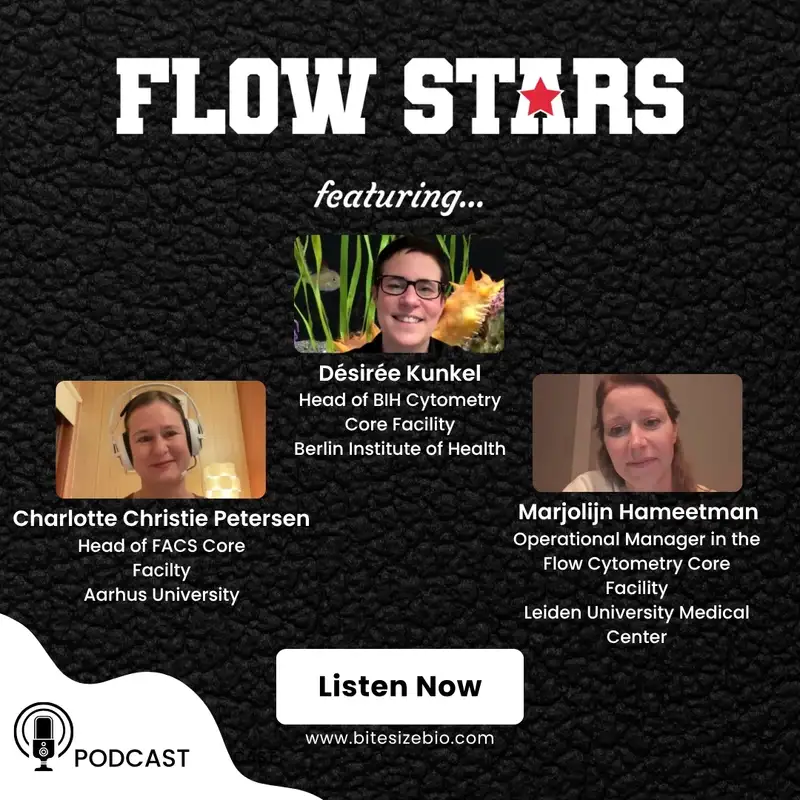

Charlotte Christie Petersen, Désirée Kunkel, and Marjolijn Hameetman
Welcome to Flow Stars, candid conversations between doctor Peter OToole and the big hitters of flow cytometry. Brought to you by Beckman Coulter at Bite Size Bio.
Peter O'toole:Today on Flow Stars, I'm joined by Charlotte Petersen, Desiree Kunkel, and Marjolijn Hameetman. The three of them behind the European Flow Core meetings. And we get to hear about an unexpected Tuesday night hobby.
Charlotte Peterson:And my hobby is gymnastics. Oh. I'm getting a bit old. It's still really fun. We are some supper ladies, 50 ladies, 30 plus in age, and we do shows every year.
Charlotte Peterson:It's a lot of fun. So even though you get old, it's something children do. It's we love it.
Peter O'toole:The moment a ceiling literally came down on a very expensive instrument.
Desiree Kunkel:So I actually had the ceiling coming down on my Hyperion. So the ceiling got soaked through with water and then the ceiling just fell on top of the instrument.
Peter O'toole:And Charlotte shares her story of falling in love not only with play cytometry, but her husband in front of the Cytometer.
Charlotte Peterson:Well, I fell in love both with my husband and the technique in front of a Flow Cytometer. Then, you know, sometimes it's also a bit of luck and timing. There helps. Right? So when I finished my PhD, a new core facility was going to start.
Charlotte Peterson:So I was lucky being employed and could grow this core facility at my university.
Peter O'toole:All this on today's episode. Hi. I'm Peter OToole from the University of York, and today on Flow Stars, it's a very special edition. I'm gonna go in alphabetical order of first name. So I've got Charlotte Petersen Charlotte, afternoon, evening even.
Peter O'toole:Good evening, Pete. Oh god. Desiree Kunkel.
Desiree Kunkel:Hi, Pete.
Peter O'toole:And I've got Marjolijn Hameetman.
Marjolijn Hameetman:Hi.
Peter O'toole:I've probably mashed your names really badly, so I apologize. I I only ever use your first names. That's it. Oh, wow. I'm so different.
Peter O'toole:So, actually, I brought you together today. I I it's really weird actually not having Derek Davis here as well. Yeah. Okay. Yeah.
Peter O'toole:Because, you you three are responsible for really initiating the virtual flow cytometry facilities forum. I I can't remember what we call what's it called?
Desiree Kunkel:European Flow Core meeting.
Peter O'toole:There you go. See? And that was, oh, okay. How many years ago?
Desiree Kunkel:I think three years ago. Right? Three years.
Peter O'toole:So three years ago.
Desiree Kunkel:So Or maybe even four.
Marjolijn Hameetman:I think it was at Saito in Montreal where we started our first meeting.
Desiree Kunkel:Yes. Yeah. Yeah. And we sat in that bakery. Yeah.
Desiree Kunkel:Yep. Trying to get a program and topics together.
Peter O'toole:Yeah. Was that the one in the crescent shape, or was that in the rectangular one?
Desiree Kunkel:The one on the crescent. Yeah.
Peter O'toole:The crescent shaped table. So that just just from small seeds, but I think the first time we discussed this was at the in person meeting. Yeah. So why why the virtual European core facilities meeting? God, who'd who'd like to answer why did you start that?
Peter O'toole:We already got one in The UK, the CYTO. So why this meeting?
Desiree Kunkel:Yeah. Well, I think it was mainly to bring together European flow calls and not only the managers, the heads, the PIs, the big bosses that have the means to travel to CYTO and to all the meetings, but also have a meeting where staff members can attend. It's like two days, half a day meeting. So even if you can only make it for one of the half days, you can attend and participate. And I think it would be difficult to bring together the European Flow Core community in person to one location traveling.
Desiree Kunkel:So if you have a two day meeting, you need to stay over. You can't bring your complete team. So I was also a bit concerned about the virtual format, but I think during the pandemic, we had so many fantastic meetings. Like, also The UK meetings, they were really good. So we thought let's give it a try.
Desiree Kunkel:And then in the end, after the first meeting, have a survey. And I think everyone agrees that it's a good format for this kind of audience.
Peter O'toole:So when you started when we started, I'm gonna go to Marjolijn next and go,
Charlotte Peterson:how successful did you think it
Peter O'toole:would be? How many how many did you actually have it in your number what a success would look like? How many people would turn up would actually make it a success?
Marjolijn Hameetman:Not at all. It was just, let's see what happens. And I think, overall, we were really overwhelmed with how enthusiastic the people were. So over 200 people I think we we did a we did a small bet at the beginning of how many people we will reach because the the registrations were already over the 300, I think, the first time we organized it. And I think we had the idea that it was only people from the from Europe who would attend, but I think we had over 30 countries, people that were attending the first meeting.
Marjolijn Hameetman:So that was really I think we were overwhelmed by already first one, the amount of people, but also the variety of people that joined.
Peter O'toole:And they did some of those other people for were for some lower and middle income countries as well, which wouldn't have the means to go to any other meeting. And, actually, collectively, there isn't, the same number of cytometers, I guess, to actually have their own local community at that point. But that that must be the same across Europe as well. It must be European countries that don't have a critical mass of cytometry to be a useful forum. I mean, Charlotte, your thoughts?
Charlotte Peterson:Yeah. Was it a big success? It was a huge success, and that's also why we continued. And we have all benefited so much from learning from other people in call facilities, getting good ideas, sharing ideas. So the idea to make the European virtual so more people could attend, it has it was something we wanted to do and it has been a success.
Peter O'toole:I I'm gonna throw a question. I'm gonna go reverse order on the questions this time. Why you? Why why why why did you organize it?
Charlotte Peterson:Desiree asked me to join.
Desiree Kunkel:And you know I think
Charlotte Peterson:Desiree yeah. Desiree should have the honor here for the European meeting. And we were all inspired by you, Pete, and Derek from The UK meetings. And I think all of us attended during the pandemic your online meeting, and it was worked really great. And we have been then in person to your meetings.
Charlotte Peterson:And then the idea simply was, well, to have a lot of people attending, it should be virtual because all of us have a limited travel budget and also with time. So two half days virtual, it works. And people are really good at keeping time, attending and being in the organizers. We get to pick the topics we find interesting, so that's also a lot of fun.
Marjolijn Hameetman:Yeah. And also I think the way the program is built, so you have the societies, you have the the tech talks of the companies, you have well, we had multiple discussions about the different topics that we would like to discuss during the meetings, but, it's like all the topics are interested. If you're it's interesting. If you're now a small core or a big core, everyone has related to these these topics. So it's useful for everyone.
Peter O'toole:And Desiree?
Desiree Kunkel:I think it was I mean, it was actually you who brought it up at one of the in person UK flow core meetings. So I think it's also that, like, making it virtual and just copying the UK flow core meeting from the structure that made it really easy. So it was just copy paste the technobytes, the crypt talks, the sessions, and also with the support of RMS. I think without the support of RMS, we wouldn't have dared to launch this series of meetings because it is it's good to have the support in the background with organizing everything and registration and so on. So yeah.
Desiree Kunkel:I mean, it was you who convinced me to get this started, and then I just called people who I thought would be really having fun also organizing the meeting. I mean, this is what it should also be about, right, to do something together.
Peter O'toole:Dr Peter, I'm going to apologize because I think do you feel as though it's actually helped your profile in the community and your people awareness of your labs because of your involvement and your leadership of this meeting? Desiree, I'll start this way this time.
Desiree Kunkel:Yeah. I mean, definitely. I mean, you know a lot of people maybe already before, but then having a European community with also people that you have never met before from countries. Honestly, when we put together the European countries, I'm embarrassed to say that I didn't know that we had so many European countries. And just to find out who you could talk to in these countries to get people aware of this meeting, already that made people more, like, accessible for networking from for also myself and my lab.
Peter O'toole:Marjolijn, anything to add?
Marjolijn Hameetman:Well, I thought after the first year, we we selected a few societies that could give a talk, but also, labs that, or float flow cores that could present what they are doing, what kind of instruments they have, and how they operate. And the second year, we asked if people are interested to to give a talk. And then also there we see the amount of responses growing, each year and also course that we never heard of. So it's nice that we can now pick, people that are are not so familiar with the community but can present what they have and let the let us know that they exist. So that's really nice.
Marjolijn Hameetman:Yeah.
Peter O'toole:Charlotte, anything to add?
Charlotte Peterson:No. I think you covered it all. I think because we we get to meet people we wouldn't have had a chance to reach out to otherwise. And I always learn something because people do things differently and some of the challenges we all have, a lot of other people have the same challenges. So to have a talk, be inspired, it's it's really, really useful.
Peter O'toole:When we think about flow conferences, the first one that pops into our head, everyone's gonna have it in their head now is CYTO. And there's a core meeting there, but I don't think you get I think the meetings that are done, the virtual European core meetings actually has more meaty topics, contents relevant to core staff overall. And I really like what was just saying. So we got those, crib talks, those invite abstract talks so people can highlight themselves. I think I get to know more people through that than I would just by going to a conference at Saito.
Peter O'toole:You tend to talk to the same people when you're at a conference, whereas here, you're getting to meet actually properly. Even though it's virtual, you are meeting people that we wouldn't otherwise have known, as Desiree said, people in countries maybe we weren't quite aware of, put it put it on the map.
Desiree Kunkel:Yeah.
Peter O'toole:Yeah.
Desiree Kunkel:I mean, this is this is true. It's it makes you aware of other labs. It it puts people out there that otherwise wouldn't get a chance to introduce themselves. And I think it's also good that in this meeting, we can focus on topics that also touch the interest of the staff members and not only the managers like budgeting or staff management, but also like further education of staff members and so on. So it's a meeting really for everybody at the core facilities.
Charlotte Peterson:Because physical meetings are still good, right? We shouldn't forget to meet in person. It also gives something special, but to have a combination. And our outreach is much bigger doing it virtually. Also, you are really busy, you can just attend for two hours, take a few talks.
Charlotte Peterson:It's for free and easy to log on and out in and out.
Peter O'toole:Yeah. I wonder, actually, at CYTO, anyone who goes to the virtual flow meeting, I wonder if we should find somewhere that everyone could just meet in person at breakfast and start to see the the real flesh and just say, look. We're gonna be here. Anyone who's come to these meetings, come along for breakfast. We'd have to find a biggish place.
Peter O'toole:And I may not be at CYTO this year, but that doesn't matter. You are. I presume you're all at Saito this year?
Desiree Kunkel:No. Unfortunately, not. No.
Peter O'toole:Because quite a few of us not going this year.
Desiree Kunkel:This is
Marjolijn Hameetman:gonna be me and breakfast.
Peter O'toole:Cameron will bring you there. Cameron's there. We go. Derek is there as well. Okay.
Peter O'toole:So maybe we need to, for next time, Saito back into Europe.
Charlotte Peterson:Yes. But but it will be in Helsinki next year. So it will be in Finland. So that would be obvious to try and make a European virtual physical Physical breakfast breakfast club.
Marjolijn Hameetman:Yes. Yeah.
Peter O'toole:Just just to make those those networks a bit, could you say the in person meetings are still irreplaceable, I think?
Charlotte Peterson:It they are.
Desiree Kunkel:They are. Definitely. Yeah. Yeah.
Peter O'toole:So we'll come back to this in a moment, but I have another question. When did you all first meet each other? Who can remember?
Marjolijn Hameetman:Yeah. It was my first German mass cytometry meeting. So that's already nine years ago. That's right.
Desiree Kunkel:Yeah. Yeah. It's true. In Berlin. Yeah.
Charlotte Peterson:And Marjolijn, I think we met you at an RMS meeting in London.
Marjolijn Hameetman:In Yes. Yep.
Peter O'toole:So is this the
Marjolijn Hameetman:Four years ago.
Charlotte Peterson:Yes.
Peter O'toole:Yes. So it's the the flow the the the in person flow
Charlotte Peterson:through In person for exactly.
Peter O'toole:Yeah.
Charlotte Peterson:And this we have met at CYTO.
Desiree Kunkel:Yes. And I think also you attended one of the maybe the German meetings, the German flow meetings. I don't know. But maybe it was CYTO. Yeah.
Charlotte Peterson:Yeah. At least that CYTO, we have met.
Desiree Kunkel:Yes. Mhmm.
Charlotte Peterson:Whenever I
Peter O'toole:meet you, you just seem like a trio, though. You just seem perfectly in tune. So, actually, so you met nine years ago, and kept on Charlotte. You only met Marjolijn four years ago. Yes.
Peter O'toole:From that start, you just seemed like a natural set of leaders really
Charlotte Peterson:We well have a lot in common. We love flow cytometry. And to have a good work environment in our core facilities. So Yeah. We get along well.
Charlotte Peterson:So this is interesting.
Peter O'toole:We all know each other from a work perspective.
Marjolijn Hameetman:Yeah. Yeah.
Peter O'toole:I don't know what any of your hobbies are. Oh my goodness. I'll start in the middle this time. Starting Marjolijn. Marjolijn, what are you what's your hobby besides cycling and crashing, which we heard about earlier?
Marjolijn Hameetman:Yeah. Not cycling. No. No. So my hobbies are yeah.
Marjolijn Hameetman:I have two children, teenage teenagers. So spending time with them, because I I work a lot, so I need the weekends also to spend time with them. That sounds really bad, though. Well, spending time with friends, walking, hiking, working in my garden. I I love to be outside, so things like that.
Peter O'toole:Yeah. K. Desiree?
Desiree Kunkel:I'm well, flow cytometry still. I would consider it as a passion and as a hobby. So perfect work life balance. No. But I also read a lot.
Desiree Kunkel:So a lot of, like, books, horror books, crime, fantasy, so on. So that's one of my passions to, like, travel to UK, to London, and buy books to read them then. So this is what I spend my time with when I'm at home and have, yeah, free time.
Peter O'toole:So you're reading the hover books in English?
Desiree Kunkel:Yes. So I I try to read them in the native language. So Okay. It's the translation are sometimes difficult to to read. So Okay.
Desiree Kunkel:Cool. And Charlotte?
Charlotte Peterson:And my hobby is gymnastics. Even though I'm getting a bit old, it's still really fun. We are some supper ladies, 50 ladies, 30 in age, and we do shows every year. It's a lot of fun.
Desiree Kunkel:Interesting. Yes. Yeah.
Marjolijn Hameetman:Just didn't even know that. So,
Charlotte Peterson:it's yeah, it's so even though you get old, it's something children do, it's we love it.
Desiree Kunkel:Mhmm. We
Peter O'toole:have And you chose?
Charlotte Peterson:Yeah. So we have series, four different songs where we have it's almost like dancing, right? So a lot of choreography and so that's I I like that. That's my Tuesday evenings.
Peter O'toole:Right. Betman Coulter. We've done a live Flow Stars for a couple of years of Betman Coulter. I think the next time, it needs to be a talent competition.
Charlotte Peterson:No need for that. No.
Peter O'toole:I quite like the idea. I'm I'm gonna talk to them after and say, I've got this great idea. Charlotte's really good at this. Oh,
Charlotte Peterson:yeah. I'm gonna
Peter O'toole:And, interestingly, so, obviously, you've worked together on the meeting. And last year, though, it wasn't just us. So we had more people coming to the floor. Why why why not just stick with yourselves? Why bring other people on board to help organize a meeting?
Charlotte Peterson:It's very important new people join because we all know the same people. So when new people join, they say, oh, I know this person would actually know something about this topic. So it's good with someone who knows the history and how we should do, but it's also very good to have new people joining.
Desiree Kunkel:Yeah. Also to give people the chance to take part in this. So I think it's it's good if you have new people who have never done this and help them and show them that the community is actually a very friendly one so that they can put themselves out there and and organize things like this together with with the community.
Peter O'toole:Why is the meeting so important?
Charlotte Peterson:I think it's so important that we share our knowledge. All of us who end up in core facilities, there's no education for it. We are all self taught leaders. We are self taught a lot of issues. And by talking to other people in core facilities and going to these meetings, you get inspired, get new ideas and realize, oh, we could actually do this differently and perhaps we would get more time to do what we really want.
Charlotte Peterson:So I have learned so much from both this society and also from attending the CITO meetings. I'm really grateful and happy if I can give just a little back.
Marjolijn Hameetman:And I think it's never ending. The instruments are continuously evolving, but also, well, all these new dyes are coming out. And also the data analysis is a big part now with all the spectral instruments. So yeah. On all these different fields, I think we our core facility is relatively young.
Marjolijn Hameetman:So, also, everything that is, involved in running a core facility is is new to us, but some people already have the facility for over twenty years. So, yeah, all these things are are changing. And I think now the focus of the infrastructure in each country, we are now looking into how can the core facilities work more closely together. So this is also something new for us in The Netherlands. So yeah.
Marjolijn Hameetman:It it's it's always something that you can talk about and learn from. So I think this will be important always.
Peter O'toole:Desiree, anything to add on that?
Desiree Kunkel:Yeah. I think with with any meeting, it's it's motivation. So, I mean, the the job is quite stressful. As Charlotte said, it's we are self teached with everything that we do, and it it's good to be motivated by other people that succeeded, that got challenged by by things that we also might have encountered. And yeah.
Desiree Kunkel:So I think this meeting especially is also important for the staff members because they sometimes don't get the chance to attend in person meetings and to to realize what what a cool community this is, how open people are to share knowledge, especially for people who come from with a scientific background that attended maybe immunology meetings or other scientific meetings. When they realize how open everyone is to share knowledge and not being secretive, I think this is a good motivation also for them if they wanna proceed and and go, like, for their future and and step up and become a leader, that they have a network and build up a network.
Peter O'toole:And so I I as you say, I think from the academic world, it can be quite competitive. And I think the flow call world, we're not competitive against each other. Although, Marjolijn, you might have got the mosaic before me, but let's not go there. And so I'm gonna ask, how old are your facilities? Not how old are you?
Peter O'toole:How old are your facilities? 15. 15, Charlotte? Yeah.
Desiree Kunkel:Mine is from 2008. So calculate.
Marjolijn Hameetman:Eighteen years. Yeah.
Desiree Kunkel:That yeah.
Peter O'toole:It's K.
Charlotte Peterson:Eighteen years.
Peter O'toole:Eighteen? Did you how many were you 14, Charlotte?
Charlotte Peterson:15.
Peter O'toole:15? 18. Marilyn?
Desiree Kunkel:Seven.
Peter O'toole:Seven. A youngster. Oh, I I'm I'm 24.
Desiree Kunkel:Yes? You're four.
Peter O'toole:I started when I was just this tall. That's all. Yeah. Nice. Yeah.
Peter O'toole:Think so. You talked about hot topics, a little while ago. What's your favorite topic? Go
Desiree Kunkel:on. Oh my god.
Peter O'toole:Who who's gonna go first? If anyone if you're all listening, everyone's just looking up at the ceiling right now thinking what their favorite hot topic is.
Marjolijn Hameetman:What have we what have we what have talked about? There's so many things, and now I'm trying to figure out what is the best topic. Cool.
Charlotte Peterson:What I like is new instrumentation because there's continuously coming new new instruments on the market, and it's really nice to be inspired and have someone present what can a given new instrument actually do. And when people are presenting coming from core facilities they are normally really honest and also saying this is an issue or I don't understand why it's not able to do this, but these parts are really good.
Marjolijn Hameetman:I also like the career path. So we had a session about development within a core. I think, well, here in The Netherlands, it's like an operator is not a a clear defined, role within the institution that we're working, but in the whole Netherlands. So, people are not really recognized for the work that I do, and I think the people working in a core facility are so I don't know. It's a certain kind of people.
Marjolijn Hameetman:So and most of the time, they are coming from research field, moving away from that, and helping others. It's a certain kind of there are certain kind of people, and I really would like for them to be really recognized for the important work that they do. Yeah.
Peter O'toole:We'll come back to that in a minute, Marjolijn. Desiree?
Desiree Kunkel:Well, I I really like talks about budget planning and cost calculation.
Peter O'toole:It's the right answer.
Desiree Kunkel:I find it really fascinating hear how other people do that because I think in the end, it's just like juggling numbers and make do. There's no science behind it. There's no right or wrong. So it's just listening to other people how they try to get that done without having the background and the proper education to do that. So I I'm I really like that topic.
Peter O'toole:I I'm completely with you, Desiree. But I would what's what's really cool, though, is if you just think about what was just saying, what Desiree just said, actually, it's the perspectives. The nice thing about having it across Europe and a few are invited outside of Europe is getting to hear different perspectives. Mhmm. And you can pick and mix what works for your environment because that's where you're absolutely right.
Peter O'toole:There's no one way, is there? It it really does. You have to find a way that works best for your environment. And I think, Marjolijn, you're right. I think our careers, we are people pleasers.
Peter O'toole:Mhmm. We like we don't we we're really bad, actually, because we never say no. Mhmm. So thank you all for saying yes for today. I knew you would.
Peter O'toole:Sorry. That's really obvious. You gotta say yes. But it is a it is a trait, isn't it? It's a right to in a core facility, you have to be a certain type of person.
Peter O'toole:You know? But it makes you no less academic.
Desiree Kunkel:And
Peter O'toole:and, you know, I don't know if anyone wants to comment. I I think a core facility, you we've applied academics rather than theoretical academics to a degree. We like to apply learn more about our skill and apply our skills across many samples. And and who's thought about the the go on. What's the biggest plus point of running a core facility?
Peter O'toole:What are the what are the big perks on a daily basis of running a core facility? Or working in a core facility, just running, but actually working in a core facility. What's going on? What's your favorite bit to that?
Charlotte Peterson:Training users. Learning the technique to new people, I get so much joy out of that when I see the students, oh, this is so cool. Yes, it is. I really like that part.
Marjolijn Hameetman:I think the troubleshooting is also also really fulfilling. So if it's not working or people have issues with, it it can be software hardware. But just making it work again for them, that's really it gives you a good feeling.
Desiree Kunkel:Yeah. For me, it's also the troubleshooting. So you can't tell the users, but if instruments break, that's when I really have fun and trying to find what causes the issue and troubleshooting, fixing it. And this is really what what makes it fun. And and also you get to learn so many new things even so when you are, like, moving and you have to, like, build your lab and you learn a lot of about ventilation exhaust that you never dreamt of having to know.
Desiree Kunkel:So this is really, really fun.
Peter O'toole:I think in my early days, it was actually the fact that I was working on prostate cancer. I was working on leukemias with stem cells. I was working on crops and looking at plant protoplasts. It was the fact that I could apply my skills to actually solve lots and help lots of different areas of life science and not just one area, which I think as a researcher, you're very obviously focused on your one area. Mhmm.
Peter O'toole:You've got that broad breadth, which I think is cool. And, again, that's where the career path becomes difficult because you can be a master at a trade, and that's where you get your career to go upwards. If you're a jack of all trades, so British phrase. So multitalented but not specializing. My hands you can't see my hands if you're listening.
Peter O'toole:So if you've got a pyramid and actually when you're doing lots, you never get elevated up because you're not perceived as expert enough, but the technology is the expertise. And, Marjolijn, I said I'll come back to that career path. I think it's great that some countries UK, I think, is really good at developing career paths for core staff. It's still tiered. Not everyone can be at the top.
Peter O'toole:It it has to be a pyramid structure. That's obviously, you can't have everyone as a leader at the top, but it does get the recognition, and it does give that career opportunity for those who are able to go. I think these meetings really help on that. And I don't know how it is over in Germany or in Denmark or in The Netherlands. Are you seeing progression with career paths and career recognition?
Charlotte Peterson:Not in Denmark, not like The UK technical commitment. I think you are really in the forefront of recognising technical people. We have been able to get my staff assigned specialists instead of yeah, that is our title now, we are specialists. And we are also happy with that title, but there's no clear career path.
Desiree Kunkel:It's the same in Germany, there's no clear career path, there's no salary levels that are dedicated for certain tasks or education. So you basically make it up for your staff and call it something that that they feel appreciated and confident to do that. But I think it's changing at the moment. So there are more and more people that are actually coordinating core facilities like yourself, Pete, that in Germany create a network and and work together. So maybe that will change in the future, but I think it's more to the the the task of the core facility had to appoint certain roles and to give it a clear name so that when you are talking to other people, you can say, okay.
Desiree Kunkel:My job is this. Because, I mean, if someone asks you what is your job, that's really, really difficult to explain.
Peter O'toole:Yep. Marjolijn, how is it in The Netherlands?
Marjolijn Hameetman:Yeah. So, I've been working on this for five years. And now at the point where we are, sitting together with all the seven academic hospitals in The Netherlands, and we're teaming up. And, hopefully, at the end of the year, we have something written down that will cover all the different core facilities, so not only flow, but also microscopy, genomics, and everything. Yeah.
Marjolijn Hameetman:So we're slowly getting there. Yeah. But it's a process.
Peter O'toole:That's another important point. We we talk about flow cytometry. Desiree, you talked about budget, but, actually, we're no different to the genomics or the mass spec or the microscopy cause. It's all all the same problems, and coming together makes it a much more powerful voice. And I think if you point across to places like The UK that have these structures and examples that are succeeding, hopefully, other countries will realize and start recognizing talent and rewarding the talent for that.
Peter O'toole:But regardless, are you all happy in your jobs?
Charlotte Peterson:Yes. Yes.
Peter O'toole:And that that is also really important because I think you gotta be careful, actually. As as the provisional pathways open up, you may end up not enjoying your job quite as much. Mhmm. I don't know if you've thought about that, about whether, actually, the stresses become greater, the obligations become greater. You get less hands on as you go through.
Desiree Kunkel:Yes. That's true. But on the other hand, I mean, who can say that they can make their passion to their job? So this is really a privilege that that you have a passion and you even get money for it.
Marjolijn Hameetman:Yeah. True.
Peter O'toole:Do you know none of you mentioned the stability in our careers compared to postdocing or, you know, in that's quite a transient post, and we have I think, certainly in The UK, our posts are pretty stable. You know, secure.
Marjolijn Hameetman:Yeah. They are.
Peter O'toole:Which is which is really which is nice. So I'm gonna move on. Charlotte, you mentioned learning about the new technologies. Yeah. But actually, a key component to these meetings are the technobytes.
Peter O'toole:So who'd like to decide what the technobytes are?
Charlotte Peterson:Well, it's a short presentation. The companies, they pay for I said three minutes, they get to a present.
Peter O'toole:Five.
Charlotte Peterson:Is it five? Okay. But it is brief. It's just five minute presentation and then people can ask in the chat and follow-up afterwards. And also when it's virtual it cannot be much longer because then people would lose focus.
Charlotte Peterson:So the presenter has to spend their five minutes wisely. But they do. And I always get some new ideas and learn about something new. It's a good mix and they finance, so we have money to do it free for all the participants.
Marjolijn Hameetman:Yeah. Really important. Without them, we couldn't arrange it.
Charlotte Peterson:Yeah.
Peter O'toole:I I they are the best adverts, aren't they?
Desiree Kunkel:Yeah. Yeah.
Peter O'toole:You know, they they are I I don't know if it was one of you who mentioned, maybe we should have a competition actually vote on the best Technobyte Yeah. And give a bit more publicity. I'm sure someone mentioned it. It wasn't it wasn't my idea. Someone else mentioned that at some point.
Charlotte Peterson:But they do it at the German meetings. Yes. Yes.
Peter O'toole:Yeah. The German meeting meeting meeting.
Desiree Kunkel:Yeah. It's it's like kind of a show. So everyone now has poems and sings and whatever stage theater they have, and then they vote for the best presentation.
Peter O'toole:And this is the this is the commercial companies doing this? Yes.
Desiree Kunkel:Yeah. They're dressing up. They're reading poems. They're singing.
Charlotte Peterson:The Germans really got a point here instead of hearing about the company histories. We have heard about that before. We rather want it to be fun, be inspired.
Peter O'toole:What do you reckon? Should we encourage that next time?
Desiree Kunkel:We could. I think for some of them, it's a challenge, but also at the German meeting, not everyone is performing. But Yeah. And those who are performing, you remember mostly the person, maybe the company, but rarely the product that they are advertising, which is okay because later on, you talk to the person and you you get to know the product then by talking to them, which we can't do at the virtual meetings. So I'm not sure that we should stress it so much.
Peter O'toole:But, of course, the virtual meeting can be prerecorded for their five minutes. That's true. Oh, they could really go to town. Yeah. And others, I we need to know.
Peter O'toole:We we want okay. I want to learn about their product. Yeah. So they do they do need to keep it on topic at the very least. But as you say, it is really important.
Peter O'toole:And that actually really helps the Royal Microscopical Society because, obviously, although it's a charity, it needs to recover its staffing costs in the background. And so, actually, the companies are sponsoring the meeting through that. It's not they they might see it as a fee for five minute advert, but, ultimately, it's sponsoring the event. And, you know, the companies that are there, you know, there's a big thank, a big thanks and a big shout out to those companies that do put in money, to enable the meeting to happen for for all of us to come together. I'd like to think they wouldn't even need a Technobyte.
Peter O'toole:Would just happily just bring their their we are their community, aren't we?
Charlotte Peterson:Mhmm.
Peter O'toole:And they are part of our community. Yes.
Marjolijn Hameetman:Fine. Yeah. And I think even within the registration, we ask people if they are giving, permission to share their information afterwards to the company. So if the company sponsor, they will also get access to all the registrations or the registrants participants that are in the meeting. And within just two half days, they have over three, four hundred contacts.
Marjolijn Hameetman:So they also like in person meetings, but if you're an at a conference, do you really reach so many people in just a short notice? I don't know.
Peter O'toole:I have to thinking about technology
Marjolijn Hameetman:Yeah.
Peter O'toole:What was your first place autometer?
Marjolijn Hameetman:Oh, yeah.
Peter O'toole:I'll start with Marjolijn on this.
Marjolijn Hameetman:There was a the I forgot the name.
Desiree Kunkel:I
Marjolijn Hameetman:only know the software. It's CellQuest Pro. I can say, oh, Caliber. Yeah. BD Flex Caliber.
Marjolijn Hameetman:Yeah. That was my first.
Desiree Kunkel:Mine too. The one laser fax caliber.
Peter O'toole:One laser fax caliber.
Desiree Kunkel:One laser. Wow. Yeah. That was in '96, so it's a long time ago.
Peter O'toole:You remember Apple 01/02/1934 to call up the windows on that?
Desiree Kunkel:Mhmm. Of course.
Charlotte Peterson:And mine was also a FxCaliber and an f c 500. And five colors on the f c 500. Oh, it was a very big experiment at that time.
Marjolijn Hameetman:I I was the first from the department developing a four color panel script. Yeah.
Peter O'toole:We had a a caliber with a sort functionality. Yes. Yeah. The nice thing about that saute, you heard when it stopped. Remember that?
Desiree Kunkel:Yeah. Also, you had huge volumes coming out of it. Right?
Peter O'toole:Oh, gosh. Yes. Yeah. And when you unclogged it, you used to get a big syringe and push it through the pipe. And if you weren't careful, if it popped off, it goes over the lasers.
Peter O'toole:Oh
Marjolijn Hameetman:my god.
Peter O'toole:I only did that once. What is your biggest accident on a cytometer? Make sure your engineers aren't listening.
Desiree Kunkel:Mhmm. So I actually had the ceiling coming down on my Hyperion. So the ceiling got soaked through with water, and then the ceiling, yeah, just fell on top of the instrument. But luckily, it it landed in a way that nothing was broken. It's very, very good, but that was a bit scary.
Peter O'toole:What system was it who fell on?
Desiree Kunkel:The IMC, so imaging mass cytometer.
Peter O'toole:Nicely covered,
Desiree Kunkel:though. Yeah.
Charlotte Peterson:Well, it
Desiree Kunkel:was running at that time. So
Peter O'toole:Marjolijn, your biggest disaster in the Flow Lab?
Marjolijn Hameetman:Except for a few floods. I cannot remember, really. Oh, nothing really weird.
Peter O'toole:What are you thinking, Charlotte?
Charlotte Peterson:No. Excellent. Oh, yeah. Well, yes. For sure.
Charlotte Peterson:I you know, but it has been silly things like forgetting to turn on the air for the sorter and not understanding why it's not working, having the lid open for the sorter and not seeing any events, silly things, having exchanged the filter, forgetting to to put the standard filter back and the next day, QC doesn't pass, spend a lot of time cleaning and thinking, oh, the instrument must be dirty and my QC must pass, right, until you realize it's your own fault. So lots of those operator silly things.
Marjolijn Hameetman:Yeah. Yeah. And but I think the more your experience you have, the the more difficult you start thinking, and sometimes it's just something so easy. Yeah. Yeah.
Peter O'toole:No one's ever put their fingers between the charge plates when it's when it's on. No. Not me. My engineer did frequently because I turn it on while he wasn't looking. That
Charlotte Peterson:was rude.
Peter O'toole:Shocking. I know. Literally.
Marjolijn Hameetman:Yeah.
Peter O'toole:I shouldn't confess to that, should I?
Charlotte Peterson:Nope.
Peter O'toole:Sorry, Ian. Sorry, Martin. That's why they got really short curly hair and no hair on the arm. Look, they play plenty of pranks the other way. Did anyone have a mofo?
Desiree Kunkel:No. No.
Charlotte Peterson:Well, we had one kind of associate. It was at the hospital. So my colleague, Anne, yeah, she used to operate it.
Peter O'toole:They they had that whole that water chilled enterprise laser. And actually, the the the water chiller came off once, and I've never seen water come out so fast because that was pumping through fast. It just the whole floppy hose just went vertical down. And, yeah, we had probably an inch of water within a minute. We're getting over to turn it off, but luckily didn't hit any of the optics.
Desiree Kunkel:Yeah.
Peter O'toole:We again, that would be a really good session.
Charlotte Peterson:Mhmm.
Peter O'toole:Comp the confessional.
Charlotte Peterson:Yes. Yeah.
Peter O'toole:The confessional always sounds good. We should ask the engineers. Oh, yeah. They'll invite
Desiree Kunkel:the team.
Peter O'toole:That's their confession. Yes. That that'd be even more revealing. When we're talking about topics for the next meeting, do you ever disagree with each other on what topics should be discussed at the next meeting?
Charlotte Peterson:There are always more ideas than what we have room for.
Marjolijn Hameetman:Yeah. So we have to vote. Most of the time, we have to vote. It's not that we disagree, but we have to vote.
Desiree Kunkel:Yeah. Yeah.
Charlotte Peterson:We are very democratic.
Desiree Kunkel:Yes. And what I really like is that once we have decided for something, that everyone is fine with going along with it. So I think that's fine. You we don't always have to agree. But once we decide something together, then it works well.
Peter O'toole:How stressed were you before the first meeting? Very stressful. There was a lot of bases there.
Charlotte Peterson:Oh my god. Yeah. Being online with more than a 100 people, we didn't know how many would show up. Right? And would people show up?
Charlotte Peterson:Would it work? Yes.
Peter O'toole:Yeah. Do you still get nervous?
Desiree Kunkel:Yes. Of course. Yeah.
Charlotte Peterson:We were nervous when you asked us. We were texting.
Marjolijn Hameetman:What should we say? Yeah. We have our own WhatsApp group, and we were like,
Charlotte Peterson:did you read the email of me?
Desiree Kunkel:What do we say? Do we agree?
Peter O'toole:It was entertaining when I got one email back saying, yes. We will do it. Oh,
Charlotte Peterson:okay. You've
Peter O'toole:had a conversation without me. Yes.
Desiree Kunkel:A lot.
Peter O'toole:You talk what? You talk behind my back?
Desiree Kunkel:Sorry? I
Peter O'toole:said you talk behind my back.
Desiree Kunkel:Of course. Okay.
Peter O'toole:So you were nervous afterwards. What beforehand and and coming up to it. What about afterwards when it when it finishes? What do you do to unwind? Because it's quite a pumped up thing, isn't it?
Charlotte Peterson:Yeah. I just
Desiree Kunkel:Then you
Charlotte Peterson:miss having a beer together.
Desiree Kunkel:Yes. Right?
Charlotte Peterson:Yeah. Perhaps we should stay online with a drink in the end.
Desiree Kunkel:Yeah. A bit a bit longer than just the debriefing. Yes. Yeah. Yeah.
Desiree Kunkel:Yeah.
Charlotte Peterson:And remember last year, the Zoom or was it Teams that didn't work? Yes. That was actually quite stressful, and it was not the IMS, but the platform itself.
Desiree Kunkel:Zoom that broke. Yeah. That was
Charlotte Peterson:And we had to postpone.
Desiree Kunkel:Yeah. It was good it
Charlotte Peterson:wasn't the first year because then I'm not sure we would have dared to do it again. Yeah. Yeah. It it it
Peter O'toole:was it was the cloud software thing that Zoom used, isn't it? It just had a complete international outage.
Marjolijn Hameetman:Yes. Yep.
Desiree Kunkel:So Zoom broke. Not not our Zoom, but Zoom In general. Yeah. Broke. Yeah.
Peter O'toole:Because we were in the room. We were
Desiree Kunkel:we were in,
Peter O'toole:but no one else could get in.
Desiree Kunkel:No. And then
Peter O'toole:one person dropped out, and then they couldn't get back in. So we knew we were locked in. We we had a lock in. So that was stressful.
Desiree Kunkel:But That was stressful. And I think RMS was so good in handling this. I mean, they they must have been very nervous about it, but they they were so good in
Peter O'toole:Yeah.
Desiree Kunkel:Just, like, getting things back on and trying and maybe switching to another platform and back to Zoom. And, I mean, it was really yeah. I mean, we had fifteen minutes delay, so that was really, really good.
Peter O'toole:Yeah. Yeah. And their comms was going out to all the delegates. And, actually, that's really hard for us to do because we don't have the infrastructure really to put these massive emails out to a 150 people. No.
Peter O'toole:Sorry. 400, I think, wasn't it, last time, registered? Four okay. Let's reflect on that. 400 people registered.
Peter O'toole:I think we had over 360 unique people.
Desiree Kunkel:Yeah. So it was really excess success. Right? So Huge success.
Peter O'toole:Did you ever think it would get to that size?
Desiree Kunkel:I No.
Charlotte Peterson:No. No.
Desiree Kunkel:So I thought it might be a 100 maybe showing up the first meeting, but, yeah, it was really great.
Peter O'toole:Mhmm. Did you think it would start to to drop out? Did you think it would carry on growing as it has? I
Desiree Kunkel:I think it would stay at that number more or less probably, but and, also, I think it will depend on the other meetings during the year. So if Saito is in Helsinki, maybe it gets less. If people have their Swiss meeting, their Austrian meeting, whatever, it might get less. But, yeah, I think it's also worth doing it for a 150 people or a 100 people. So Yeah.
Desiree Kunkel:Yeah.
Peter O'toole:I think the Zoom chat
Desiree Kunkel:Yeah.
Peter O'toole:Works nicely because everyone can say something. They don't have to wait for a turn to comment. They can just put it in the chat so everyone can interact.
Charlotte Peterson:Yeah. Yeah. And people are really good at doing that. The chat is extremely active.
Desiree Kunkel:Yeah. Yeah.
Peter O'toole:And how do you find chairing a meeting and chairing the chat?
Marjolijn Hameetman:So we do it together. Right? We have two people. We have one chair who is, well, giving the introduction to the the ones presenting, and we have then the co chair keeping up track of all the the chat that is going on. So and with the newbies, last year, we we always made sure that they were sharing with someone who would have experience before, and that worked pretty well.
Marjolijn Hameetman:They did a they did a great job. Also,
Desiree Kunkel:my having the WhatsApp group as a backup to just quickly say if things don't turn out so well or if things are really interesting, should we give that person another minute more to and then talk and to hear about the interesting topics? So I think this really helps to to talk in between also with the organizers.
Peter O'toole:So you're chairing. You're reading the chat. You're trying to listen to what the people are actually talking because we wanna learn learn about it, and you're reading a WhatsApp group. Mhmm.
Charlotte Peterson:Multitasking. Multitasking. It's quite there's a lot of logistics, aren't there?
Peter O'toole:That's the logistics at the time. Mhmm. But on how many meet I can't remember how many meetings do we have before it to actually organize it.
Marjolijn Hameetman:Six to eight meetings, by
Desiree Kunkel:the way. Six to eight meetings.
Charlotte Peterson:Yeah. It's quite Yeah.
Desiree Kunkel:We should get started on the next one.
Charlotte Peterson:Yeah. I know
Marjolijn Hameetman:we we do a side of we have a lunch or coffee in the morning, but where are you?
Peter O'toole:So, Mola, it's over to you.
Marjolijn Hameetman:It's up to me. No. Yeah. Sometime it's just some yeah. Around May, June, we start, and then we finish up already before November.
Marjolijn Hameetman:And November is just the the final touches of the meeting mostly.
Peter O'toole:Take six to eight meetings plus the meeting itself. This takes time.
Marjolijn Hameetman:Oh, yeah.
Peter O'toole:How how do you justify the time to yourself? You you're run running busy flow course. You're all running big successful flow course. How do you justify the time? Why do it?
Peter O'toole:Yeah. Why do it? Full stop. Why do it?
Charlotte Peterson:It's so rewarding.
Desiree Kunkel:Yeah. It's fun. Yeah.
Marjolijn Hameetman:Yeah. It's it's really nice to do it together with you all. So, yeah, it's always nice to see each other and just it's yeah. You work a little bit extra. That's what you do.
Marjolijn Hameetman:Yeah.
Peter O'toole:And you've got children. You've got a family, and you still find time for it.
Charlotte Peterson:Yes.
Peter O'toole:That's why you have to wait for the weekends. You mentioned that.
Marjolijn Hameetman:I already instructed him, so don't come down. I'm in an interview. I don't want you see walking by grabbing something to drink and go back.
Peter O'toole:No. If someone was in a different region or a different community such as genomics or mass spec, what would be your advice to them starting out? What would be your top tips? We'll go round one by one of a top tip each of what they should think about, what they should do, or how they should encourage each other. So I'll start with Desiree this time.
Desiree Kunkel:Talk to other people. I mean, this is the most important thing, think. Don't be shy. Don't be afraid to talk to someone else. It's there shouldn't be any competition in that community.
Desiree Kunkel:So everyone is at least in the flow cytometry community is open to share, and this is the most important thing. Enlarge your network. Charlotte.
Charlotte Peterson:Find someone from different countries, from slightly different settings, smaller, bigger cause, smaller yeah. So because everybody will have different perspectives, I think that's good to include.
Peter O'toole:Yeah. Marjolijn?
Marjolijn Hameetman:I think the first ever first meeting we had, we had, like, a brainstorm session. And I think that was a a good starting point, to get all the topics out there, and then just made a selection, and have the other topics. If it's really successful, that's what we discussed. If it's really successful, we can use the other topics as well. And I think the list is always the list that we take along, for the next meeting.
Marjolijn Hameetman:What have we been talking about and what is what is left? What what are the things that we still want to to discuss? Yep.
Peter O'toole:I think we balance those topics. We didn't always put the three best topics at the very start. So there's always a top topic, if that makes sense.
Desiree Kunkel:We still have that list, the handwritten list. Yep.
Peter O'toole:Let's keep going around. Desiree, any more tips?
Desiree Kunkel:I I think so you asked the questions why do you do it, and it takes time, and how can you justify it. I think it's people are talking a lot about work life balance, but isn't this also, like, more than just work? It's part of your life. So if you consider it being part of your life, I think you start enjoying it much more than if you're stressed out by saying, okay. You this is part that gets cut off my work and how do I justify it.
Desiree Kunkel:So I think if you start like that, then you say, I'm enjoying that. I'm enjoying meeting other people and getting my motivation from it. That makes things a lot easier and more fun.
Peter O'toole:So it's your passion.
Desiree Kunkel:Yeah.
Peter O'toole:Yeah. Charlotte?
Charlotte Peterson:I think also I could say I have learned so much from all my international colleagues. My core facility runs much better after I have talked and been inspired by all of you. I and it's every time I meet, we learn something new. So it's an investment of time, but you get much more back.
Peter O'toole:Mhmm. Marilyn, any other top tips?
Desiree Kunkel:Oh, I
Marjolijn Hameetman:think already a lot has been discussed. But I've
Peter O'toole:got one. Yeah. Try and find something like the World Microscopical Society. Oh, yeah. Organize the logistics behind it.
Peter O'toole:Yep. We started the in person meetings for the Light Microscopy community without the RMS. We just did it ourselves. And then as it got bigger and bigger, the logistics become more and more difficult. The finances to to to sort it all out.
Peter O'toole:I don't wanna be a bank Mhmm. For an event. That that's not what we do. And, actually, I think different societies are really useful because if there was a surplus, it's in a charity. We're saying feeds back into the community, which I think is really nice.
Peter O'toole:And the RMS for fluoromicroscopy would do anywhere across the world. I can say that. I've got my RMS hat on at that point. Mhmm. But if you're in a mass spec or genomics community, there will be societies that will probably be able to help with that.
Marjolijn Hameetman:Yeah. Good point.
Peter O'toole:And if they don't okay. So if you couldn't find it, what would you have done?
Desiree Kunkel:Good question.
Peter O'toole:We'd have just done it, wouldn't we?
Desiree Kunkel:Yeah.
Peter O'toole:We'd have found a way.
Desiree Kunkel:Mhmm. Yeah. Yeah. But it would have been much more difficult.
Marjolijn Hameetman:And stressful. Yeah.
Peter O'toole:And more work.
Marjolijn Hameetman:Yeah.
Peter O'toole:But I know we would have done it.
Desiree Kunkel:Yeah. We probably would have done it. Yes.
Marjolijn Hameetman:Well, I think and and also, Desiree and and Charlotte, we next to this, we do we also organize other events, but then we don't have the RMS. And I think the work that RMS takes out of our hands is really a lot. So, yeah, if you could do it with with us with something like the RMS, it would be really helpful.
Desiree Kunkel:And it's the small things that you don't think about, like having a website, having some button to click for registration, having a contact for the sponsors, having the possibility to put money in a bank, however that is working. So this is maybe not obvious, but it is it's really difficult to do if you don't have a society like that backing you up.
Charlotte Peterson:Also because our national our national societies help organizing our local national meetings, right? But to have a joint European, it's great the RMS is happy to help because the Danish society wouldn't I'm not sure they would help for such a meeting.
Peter O'toole:I think the IMS is lucky because it has staff, paid staff.
Desiree Kunkel:Mhmm.
Peter O'toole:And and that I think really helps with that side. We've only got a few minutes left, I'm gonna ask you, how did you all get into what how did you get into closed cytometry to start with? Look. I love my microscopy as well, so I've got two hats. But how did you get into flow?
Peter O'toole:Maryland first.
Marjolijn Hameetman:Yep. So back in 2004, I was done with school, and I started at the rheumatology department. A lot of immunology, so, of course, I came in contact with my first flow cytometer. It was so interesting how it worked that I was directly in love with with the technique. And all the new flow cytomers that came in, I was always one of the first people hopping on and trying to learn everything about it.
Marjolijn Hameetman:And twelve years ago, I I started with a four color panel, then it became 37 color panels. So, yeah, after fourteen years working in a research lab, I, the facility was established, and then they needed an operator for a mass cytometer. And I thought, well, this is my my time to start something really different and do something I like. So using these techniques, but also helping people out, it was, like, yeah, perfect combination.
Peter O'toole:Charlotte?
Charlotte Peterson:Well, I fell in love both with my husband and the technique in front of a flow cytometer. So and I and then, you know, sometimes it's also a bit of luck and timing that helps, right? So when I finished my PhD, a new core facility was going to start. So I was lucky being employed and could grow this core facility at my university.
Peter O'toole:Did you genuinely meet your husband in front of a flow cytometer?
Charlotte Peterson:Yes. He taught me flow cytometry, and we stayed there for many hours, and so far we are still married.
Peter O'toole:There's so many puns that could fall into that that side. Desiree.
Desiree Kunkel:So, yeah, I have a background in immunology, and, of course, you use flow cytometry for all the experiments. I try to use flow cytometry for everything. So when the cytometric beat error came out, I skipped my ELISAs and went for flow cytometry. So, basically, I've never done anything else. And I was really relieved when I found out that there's actually a job that you can do and just do flow cytometry.
Desiree Kunkel:So, yeah, I think it's a background, a good education that that makes the technology accessible to you and understand it and also get a passion for troubleshooting. This is what what helped me. And then, yeah, as Charlotte says, sometimes it's just being at the right time at the right place. I was recruited to start up a new core facility and a new institute, and, yep, I'm still there and still love my job. So
Peter O'toole:That's cool. We are up to time. I'm gonna say, so I mentioned earlier that it takes a special breed to work in a flow cytometry call. I think it also takes a special breed to run these type of meetings. It goes beyond just your daily bowl.
Peter O'toole:It takes your evenings. It takes time, different bandwidth. And you are three amazing, inspiring cytometries that have really helped deliver this. And you said over 360 people, different people benefited at the last meeting because of what you've done. And, you know, that that's that's huge.
Peter O'toole:Have you ever reflected and just thought, oh, yeah. Had had a part in that. It's impact. It's real impact. Everyone's glowing and gone red, by the way.
Peter O'toole:It's it's really just what's the end of it. They're going red. But it is. When you reflect on what you've done, that's a massive impact. How many people have you helped through those meetings?
Peter O'toole:Whether it's how to do their finances or maybe correct helping develop their career paths or learning about new technology, and they've applied that to a new science, you know, your three favorite topics. Those topics are only on there because you wanted them on there, and you brought an audience to that topic. Yeah. I'll leave you on that to reflect. Charlotte We need a drink.
Peter O'toole:Charlotte, Desiree, Marilyn, thank you so much for saying yes. I knew you'd say yes. Thank you, everyone, for listening to Play Stars. Please watch the other. I'm gonna big shout out to Bettman Culture and the other Technobike sponsors as well because they actually help this massively also, and we've spoke a lot about everything, Kelsey.
Peter O'toole:Thank you very much for all of you. Can't wait to see you again soon.
Desiree Kunkel:Yeah. Thank you. Bye. Bye. Bye.
Creators and Guests