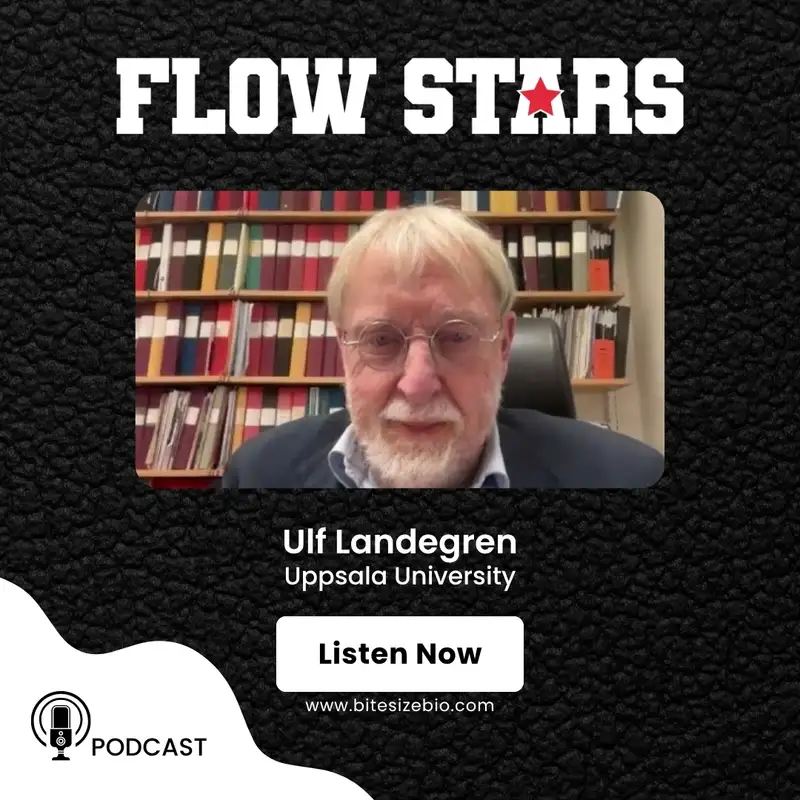

Ulf Landegren (Uppsala University)
Welcome to Flow Stars, candid conversations between doctor Peter OToole and the big hitters of flow cytometry. Brought to you by Beckman Coulter at Bite Size Bio.
Peter O'Toole:Today on Flow Stars, I'm joined by Ulf Landegren. This is amazing. And he shares how a breakthrough discovery in DNA amplification almost didn't happen.
Ulf Landegren:This circular DNA, if it's wound around another strand, my expectation was that it would really not be possible to copy that because it would be too busy hybridizing something else. Leigh didn't bother with my objections, so we went ahead and did the experiment and it worked beautifully. And this is the essential element of the, what we call, the super running circle amplification method.
Peter O'Toole:How a simple idea turned into a powerful new method.
Ulf Landegren:So this is a technology that allows you to monitor if patients, tumor patients have been cured or if they still have signs of the mutation still in their bodies. It's particularly suitable for leukemias and so we have a technology that provides exquisite sensitivity for sequence variants. So if you know sequence variants that are present in tumor tissue, but not in normal tissue in the body, then we can trace it.
Peter O'Toole:And have scientific debates sometimes spill into family bike rides.
Ulf Landegren:So my my middle son, the scientist son, we often bicycle together, but we often end up in fights over scientific matters, and so so we scream at each other as we bicycle through the landscape and scare people along the road.
Peter O'Toole:All this coming up in today's amazing episode of Flow Stars. Hi. Welcome to Flow Stars. I'm Peter OToole, today I'm met by Ulf Landegren from Uppsala University. And you know what?
Peter O'Toole:So many other things. Ulf, I I you're a superstar. I don't know if you ever thought about this.
Ulf Landegren:No. I didn't, for sure. Well, thanks very much for having me here.
Peter O'Toole:I I every now and then, I I know we just had a brief chat, but I I get slightly starstruck. I I I I yeah. Just this is me being slightly flabbergasted at you saying yes, and your achievements in your career are really outstanding. They're they're they're just unbelievable. So, actually, for for those listening, Ulf is not just a professor.
Peter O'Toole:He's not just a great academic. He's also been hugely successful in the commercial world. And yet, we'll get there. We'll get there. So, Ulf, maybe the do you know, I'm gonna start with a different question to start with.
Peter O'Toole:Really take you right back because I we know where you got to. When you were a young boy, maybe eight, nine, 10, can you remember what the first career that you dreamt of being?
Ulf Landegren:Not really, but I I think I actually had some idea that I would. I was interested in research at an early age, maybe not eight, nine, but let's say 11, 12. I think then I spent some time I was allowed into the grown up part of the library at my hometown. And they had a little section on science books. James Jeans was a physicist who wrote popular books about science.
Ulf Landegren:So at an early age, I started reading them. I didn't really have a scientific background. Father was a farmer and not so highly educated. I think very clever, but not so highly educated. So I didn't really I think when I thought of science, I thought more of being an inventor rather than understanding nature.
Ulf Landegren:And and that appealed to me.
Peter O'Toole:So I I I love the inventor bit because that's very much where you've ended up in many respects. But after that, so that was physics. But what what what was your first degree in?
Ulf Landegren:I I have a medical training. So actually, my my career is a little unusual. I had an unfinished love affair with a girl out of high school, and she got a job at the Agricultural University here in Uppsala. So I got a job at the Agricultural University. It didn't pan out.
Ulf Landegren:I pursued her in vain. However, I ended up in a lab that had some funding for doing research. But the person who ran the lab was completely uninterested in doing research. He was interested in teaching. So at the tender age of 19, I had a lab to myself and there were competent people around.
Ulf Landegren:A guy called Oliver Smithies had invented a type of polymorphic markers for humans, isoenzymes. So I just copied what he did, but for barley, for the plant barley, because this was at the University. People had started working on that before me, so I wasn't a pioneer. They had set up four assays and I set up another 28 assays and published a paper when I was 20. But then I felt I needed some real education.
Ulf Landegren:So I studied a little math and then I went to med school and finished med school. And then I did my PhD in cellular immunology, but I didn't enjoy myself so much. If you want the whole story, went I was infatuated with France. So I thought I'd spend my postdoc on cafes in France. My wife doesn't speak French.
Ulf Landegren:So she said, no, we're going to The U. S. So we went to The U. S. And this was very lucky.
Ulf Landegren:I ended up in a very powerful lab by led by Leroy Hood, famous biotechnologist and scientist at Caltech. And his lab, among many other things, it credited with having created the machines that do molecular biology. So the machines that synthesize and sequence DNA and protein, all four came out of his lab. And I think that was perfect for me. It was a very well funded lab at the really cutting edge of science.
Ulf Landegren:Lots of freedom to do what I pleased, very unguided. And I did have a very hard time there because I knew nothing, and it took me a long time to get started. But eventually, I got some things going. So for me, it was really fantastic experience.
Peter O'Toole:How did you culturally find going to The US? Well,
Ulf Landegren:US is a big country, but there are many subcultures. So if you're at Caltech, you don't meet people that I mean, it's a very special subset. So lots of people were from around the world and there's it was very easy to relate to the people around there. Everybody was sort of a temporary visitor. There were some 100 postdocs or so in the lab, huge.
Ulf Landegren:And everybody was in the formative age, families as well as building their careers. And most people were extremely talented and I mean, highly selected for being there. So it was a fantastic experience to be with this very creative group. I say, I was trying to reinvent myself. So learning molecular genetics, which I had no experience in and it took me quite a while.
Ulf Landegren:So I had a very long dry spell and very poor success in my research for the first three years of my postdoc. And then things started turning for the better.
Peter O'Toole:That that's quite a long time. So how long did you stay in The US before you
Ulf Landegren:It was almost five years before I left.
Peter O'Toole:And then back to Sweden?
Ulf Landegren:Yeah. Then straight back to where I came from.
Peter O'Toole:So you never got to France?
Ulf Landegren:No. I didn't. I I visited everyone. So my my infatuation with France has is milder now.
Peter O'Toole:I I've never gone back to The USA either.
Ulf Landegren:Okay. No. Well, I I we founded a company in in South San Francisco. So I had some business in US, but I never worked in The US again.
Peter O'Toole:Okay. So okay. So you're into your you you went back to Sweden. What did you do when you went back? Was that to have your own lab?
Ulf Landegren:No. No. Well, sort of, I got a starting starting funding, and I was trying to reinvent myself as a medical geneticist. So I spent time studying genetic disorders. But I also had this more technological at Caltech, I had started working on a very technological project, trying to use the enzyme DNA ligase to detect genetic variation, something that eventually became what is now referred to as GWAS genome wide association studies.
Ulf Landegren:So the possibility of meshing lots of genetic variants in very large numbers of patient samples. I had an early start on that. And then I thought I'd try to apply it for more useful stuff studying patients, but I didn't really have the interest in that. I kept coming back to more basic technology development. And that's I think we've been more much more successful in technology development than in the more applied areas.
Peter O'Toole:Know if you you've been a bit more successful when you have, is it four, five startups or or really, they're not startups. That's not the right word to use. So you've got four or five companies that that have come out from your work.
Ulf Landegren:Yeah. Maybe more. Maybe more like 10 or so. But some of them are gone. They have been so I didn't bought one of them.
Ulf Landegren:And one is on the stock market now in Sweden. And some others were shipped off and sold off. But there are four current ongoing companies that plus Olink, which I no longer have anything to do with. They were required by Thermo Fisher. But there are four that I'm still involved with and I'm sitting on the board for.
Peter O'Toole:Olink is huge.
Ulf Landegren:They struck gold. They turned out to be a need for their technology.
Peter O'Toole:I I that that's what just amazes me that you've you've had 10 around 10 different companies. Some have floated on the stock market. Some have been purchased by Agilent, by Thermo. You know? This is an amazing track record as a career.
Peter O'Toole:Many academics would go, right. That's my that's my out. Once I've done that, you know, I I I've made my money. I'm comfortable. I said, but here you are, still at Uppsala University, still in academia.
Ulf Landegren:Yeah. Maybe at this point, I really need to point out that I've been blessed with fantastic students. And they have been doing a lot of the work, including for the topic of this discussion, I think, where I had a student called Lei Shen, who was very important. But for everything that has been successful, there's always been somebody in the lab that's been the driving force. And often they have had much better ideas what to use the techniques for both how to get them to work, but also what the commercial potential of the techniques might be.
Peter O'Toole:So you must have chosen choosing the right people, the right students. It's not just a case that you've been blessed with good students. You must have chosen to interview the right aptitude of students to come through with that mindset.
Ulf Landegren:Now even that I don't take much credit for. I I think they found each other. I think we had a very successful lab with very talented people for a while at least. It's a little it's a smaller lab, not not the same critical mass. But they found each other.
Ulf Landegren:I think it was a very attractive lab to join because of the other students. The DNA work, there was a guy called Mats Nielsen, who was prime mover there and he's kept working on in that. He's now his own professor and pursuing the work and starting his own companies. But he was extremely important. And for the work that became Olink, Simon Fredriksson was completely decisive.
Ulf Landegren:I mean, to a great extent, it was his ideas. And he pursued it after leaving my lab as a postdoc. And so so he should have a fantastic amount of credit for that. And that's true for everything else that's been successful. There's been somebody behind everything besides myself.
Peter O'Toole:But you're still there at the helm
Ulf Landegren:Yeah.
Peter O'Toole:With the ideas, with the drive, with the so you you know, it sounds like you as a leadership type philosophy, it sounds like you're someone who is happy to give people their own responsibility and let them get on and give them independence. Would that be accurate?
Ulf Landegren:Yeah, I'm certainly very happy that people take responsibility and we've been relatively well funded. You see all the grant application binders behind me. So it's been a lab where we had the resources to try new things and often it's been successful.
Peter O'Toole:So I so for those who are listening, in Ulf's background, I can see one, two, three, four, five shelves, all wrapped with folders and more on top and wider. And so of all the different grant applications, I used to keep my grant. They're all electronic now. So once you're electronic, do you now print them off?
Ulf Landegren:None of are the last ten years or so. These are old. So so the last ten years, everything is in my computer now. So but this is the old stuff. I haven't taken the trouble to throw it out yet.
Peter O'Toole:Yeah. There's a lot I bet there's a lot of history and some awesome work within that. Just before we go off too much on the company side, did I read that your companies that you have at the moment have over a thousand employees?
Ulf Landegren:Yeah. That's probably true. But the O'LINK is the bulk of it. O'LINK proteomics is almost a thousand alone. So the others are much smaller, but maybe another couple of hundreds or or something.
Peter O'Toole:I know. Have you ever sat just reflected how 400. That's an awesome thing. You could you've given people forget your PhD postdocs and you've given them careers, you're actually for the country, you are actually employing your jobs, what you spun out is employing well over a thousand, maybe 2,000 then if you put the other companies together with the O'Lean side of things. Thanks to you and your team, but it wouldn't have happened without you.
Peter O'Toole:And that's a lot of careers, families living off what you've done.
Ulf Landegren:Well, again, I've had a part of it, but lots of people have been involved. So I think we're spending too much time on me in that respect. But I'm I think also, we may do some good. I think what O'Lynk is doing right now, I think, can really prove helpful. We understand this each better.
Ulf Landegren:And rarity, which I think is a topic of our discussion, I think they there's a potential that, that kind of technology can really help save lives and help give the right drug to the right person.
Peter O'Toole:So on the rarity side, Gon, for the audience, would you like to explain what is it so special about it?
Ulf Landegren:Yeah. So this is a technology that allows you to monitor if patients, tumor patients have been cured or if they still have signs of the mutation still in their bodies. It's particularly suitable for leukemias. And so we have a technology that provides exquisite sensitivity for sequence variants. So if you know sequence variants that are present in tumor tissue, but not in normal tissue in the body, then we can trace it.
Ulf Landegren:And even if one in one hundred thousand copies of the genome in your sample comes from the tumor and the rest is from other cells in the body, we can find it. And the nice thing is that the assay is quite simple to perform, doesn't involve washes or so you just keep adding and incubating and adding and incubating. And then you stick it into instruments that are present in all labs already flow cytometers. So I think it's an attractive method that can be implemented readily in many labs.
Peter O'Toole:I I so this this you know, it's just incredible what it can do. You instantly, you can see you know, we talked about the employees of the companies, but now you're making an impact on tens, hundreds of thousands of lives. So now it's just lay public are benefiting from this, which again is just such a great impact. Where did the idea start from? Did you see a problem and want to solve it?
Peter O'Toole:Or did you see a technology and think how can we use this technology? What can we solve? Where did it start?
Ulf Landegren:Yeah. So a little bit more technically, have been working on the simple idea that you can circularize probes. You can have linear oligonucleotides, the two ends of which can hybridize next to each other on a target sequence and that gives rise to a circular piece of DNA. Once you have a circular piece of DNA, then there's a number of things you can do with that. If you have a polymerase and the primer, then you can copy that circle.
Ulf Landegren:But since there's no end of a circular molecule, the polymerase will just run around this circle round after round. And if you wait a while, you will have maybe 1,000 copies of whatever sequence information was present in the complement of the circle. So we call the circular probes padlock probes, and it's something we've working on for ages and built several companies on. The rolling circle mechanism also is very old. We first published on that in 1998.
Ulf Landegren:Padlocks were first published in 2004. But since the beginning, I have been trying to sort of have two consecutive reactions. I wanted to have one of these rolling circle reactions feed into the other. And I had some vague ideas how to do that and many false starts. And eventually, I had a student by the name of Lei Shen, who was persuaded to spend a lot of time on this.
Ulf Landegren:And one of the things I told him not to do was exactly what he did and which turned out to work beautifully. I specifically advised him that this probably would not work. And so this circular DNA, if it's wound around another strand, my expectation was that I would really not be possible to copy that because it would be too busy hybridizing something else. Leigh didn't bother with my objection. So we went ahead and did the experiment and it worked beautifully.
Ulf Landegren:And this is the essential element of the what we call the super rolling circle amplification method. I can describe it for
Peter O'Toole:So those who are
Ulf Landegren:the key is that the sequence that you're interested in, you try to capture in the DNA circle. There are several ways you can do it. One way is to just do a couple of PCR cycles to amplify sequences that may or may not be mutant, depending on if the sequence is from the mutant or wild type genome. Then you can circularize one of the strands of the PCR. So you get a single stranded DNA circle.
Ulf Landegren:Next, you replicate it. And if you wait a while, you will have generated 1,000 copies of the complement of the circle. So if it was derived from a normal cell, you will have 1,000 copies of the wild type. If it was from a mutant cell, you will have 1,000 copies of the mutant. Then you come back with one of these circularizing probes, the two ends of which hybridize next to each other.
Ulf Landegren:And you have two of those probes, one specific for the mutant and one for the wild type. Now, these probes are pretty good at distinguishing sequence variants, but they will make a mistake. And the frequency of mistake would set a limit to how sensitive you can be. But if you started by making 1,000 copies, and let's say, you make a mistake once in 100, well, that means that you have nine ninety correct answers and 10 incorrect answers. So you don't care.
Ulf Landegren:You get the right answer anyway. And this is a reason we can have this perfect acuity genotyping, so we never make a mistake. Then once that the genotyping padlock probe has decided that, yes, this molecule is probably mutant or it's probably wild type, then it turns out that you can replicate it again. This is the step that Lei Chen tried against my advice. And he was able to amplify that again another factor of 1,000.
Ulf Landegren:So now you have first 1,000 fold application and times another factor 1,000. So you have a million fold application. And that turns out to give you rise to a big nest of DNA. For every starting submicroscopic DNA circle, you now get something that's almost visible to the eye. It's several microns in diameter.
Ulf Landegren:And you can even lay demonstrated that you could use a mobile camera to take a picture of it and see it. So you've gone from something submicroscopic to something very tangible. And you can then just label it mutant if it was from the mutant wild type, if it was the wild type. And we found out that if you stick it into flow cytometer, it will happily count the bundles of DNA as if they were cells. So it turns out to be a very clever way of genotyping.
Ulf Landegren:You can now if you spend a minute in the flow cytometer, you will count to the million of these objects. So if 10 of them were mutant, then you have a frequency of one in hundred thousand that are mutant.
Peter O'Toole:And, of course, you could sort them as well-to-do downstream analysis also with them on the flow cytometers. Yep. But it's not just RNA. You've got the proximity probes as well.
Ulf Landegren:Yeah. For protein, we have a slightly different technology. But again, the common denominator is that early on with the genotyping work, this was back in 1988 at the emergence of the Genome Project, we realized I realized that there would be a lot of DNA sequence information. And we already know that we inherit our properties from our parents. And it was foreseeable that once we had the total genome sequence, we will find a lot of genetic variants.
Ulf Landegren:And we also know that many diseases are heritable. Monzygotic twins will share disease more often than dizygotic twins, who will share disease more often than the people on the street. So clearly, there was a lot of information there. And therefore, I began a long project to try to learn as much about genetic variation as possible and develop techniques that would be able to sort it. And this is what we now call genome wide association studies, which has become a big business, which I have contributed very little to because it was taken over by much more powerful labs.
Ulf Landegren:But anyway, it's been a powerful way. So the way we did this genotyping was using the ligation of two synthetic DNA strands because ligases will object to ligating the DNA strands if they're mismatched. So if there's a genetic variant.
Peter O'Toole:I'm just thinking about this how it's been taken up by other labs and they've developed it further. You must have obviously put patents behind these concepts. At what stage in your early career did you think I should just publish it or no, I'm gonna patent it and then publish it? How what was what was the thought process at that point? Because there's lots of scientists in that position, And they just go, let's just publish it.
Ulf Landegren:Yeah. So as a PhD student in Sweden, I actually invented something that turned out to be relatively successful. I think many companies use that method to screen for monoclonal antibodies. It didn't cross my mind that I should patent it. It wasn't nobody did and nobody suggested I should.
Ulf Landegren:Then the lab I was in, in The U. S, even for The U. S. In the '80s was early in thinking about commercialization. So Lihud created a company called Applied Biosystem, which was became a very successful company.
Ulf Landegren:He also, I think founded Amgen and other very important companies. So when I came up with this ligase mediated genotyping method, the tech transfer office of Caltech quickly got hold of it and just wrote a patent. And very quickly, they sold it on to Applied Biosystem. And they even turned it into a product within a small short span of years. So I quickly got insight in the possibility of commercializing things.
Ulf Landegren:So when I was back in Sweden in 'eighty nine, I had this idea that I like to work on technology. And if it looked like it was potentially useful, then I should try to patent it. So we've been patenting a lot of things. Then we may not have always been so tactical about our patents. I think many of the products have only a reason when the patent have expired.
Ulf Landegren:Or for instance, for the OLEC proteomics technology, I think that's a particularly amusing story. We licensed the technology. This I haven't explained, but the proximity ligation is sort of connected to the rest I've said. Because in genotyping, we use DNA strands that should be ligated as evidence In that you had the target protein detection, we put DNA strands on antibodies. And if they are in close proximity, because they bound the same target protein, then we can join them by ligation.
Ulf Landegren:So same idea applied to the protein world. And then you get a DNA product that tells you that, yes, the protein was there. OLINK has now shifted, so they don't like it anymore. They use a polymerase instead, but it's sort of the same effect.
Peter O'Toole:But
Ulf Landegren:then we have sort of just continued working on the same theme. And we wrote the patent. I had a first patent written in 'ninety six for this idea and then another one by Simon Friedrichs and myself around 2000. And in 2005, we sold the idea of Proximal Ligation to Applied by System. Applied by System doesn't exist anymore.
Ulf Landegren:It's now part of Thermo Fisher. Twenty years later, we sold the same idea for the same basically the same idea after the patent expired for 300 times more money to gain to Thermo Fisher. So so they acquired the company, Olin Protiomics, working on the same idea, which we had already sold them. So it's
Peter O'Toole:been I don't even know how that can happen. But okay. Obviously, it can.
Ulf Landegren:Well, they didn't buy the company for its patents. They bought it because we then had a successful business around it.
Peter O'Toole:Yeah. And the know how and the brand reputation. And I I it's just incredible. And and how do you balance? Because, obviously, do you once once you've got the pattern, do you let others get on with it and where it's going so you can concentrate on your academic endeavors?
Peter O'Toole:Or how much how much involvement have you had with the negotiation with the with Thermo, for example, or applied biases? How much of you time has that taken up on you, or, you know, are you just working twenty four hours a day?
Ulf Landegren:Yeah. No. No. And, again, I I it's really important that I give credit to where credit is due. So I'm not a very good businessman and not even good at developing products.
Ulf Landegren:So my lab has been a good place, think, for my students and myself to explore new ideas. And sometimes we've come up with ideas what to use it for. And then we've had people with much more business skills. And in many cases, those people have been my own students. So Mats Nielsen was a prime mover for the circularizable probe, the padlock probes, as we call them.
Ulf Landegren:He has stayed in academia, but he's been very active and very clever about starting businesses. And Simon Fredrickson, even more so, the person centrally involved with the proximity ligation assay or proximity extension assay, the technology behind O Link. I am a little unhappy that he probably has gotten a little too little credit for this because he really had a fantastic role in developing that technology inside my lab, but also outside my lab after he left my lab. And he is a much better businessman than I am. He was the CEO of Rolling for a while.
Ulf Landegren:I would have been completely useless as a CEO for the company. So I've been very careful to stay in academia. However, I have been engaged in the I'm on the Board of the companies, and I like to think about what they should do next. But more commercial thinking, think my the companies I work with would be the first to say that I don't have much to offer.
Peter O'Toole:I but you've done the hard bit in a way. Well, okay. For you, the easy bit. The others have done the hard bit, but on the other side, you've also done the hard bit, which is that that starting point.
Ulf Landegren:You'll need both. Yeah.
Peter O'Toole:So over your career, I I think I probably got an idea of this already, but who's been your inspirations?
Ulf Landegren:Science is very alluring. If you read about I I think I'm very early on, I I I read there's an English physicist called James Jeans. So when I was in my very early teens, I read James Jeans. That was my introduction to science, I think. And I'm I'm very attracted to really stellar science.
Ulf Landegren:The Richard Feynman, who was the hero at Caltech where I did my postdoc, passed away towards the end of my stay there. But is a very interesting person. And so I've been very infatuated with the sign of the type of stellar signs, so signs that goes beyond signs where you'd how the hell could that look? Sorry.
Peter O'Toole:That's okay.
Ulf Landegren:My wife is calling me with us to do the thing. So have been very much inspired by some scientists like That can be I think people tell me that people like Richard Feynman probably has destroyed a lot of careers because he set so high standards for what science should be like. And most people are not like that. But it's also very inspiring to see when science is done right.
Peter O'Toole:So other than your inspirations, the next question is motivations, which I think is two different things. So is there anyone who helps motivate you? Or and actually, just what does motivate you? Why do you wanna keep inventing?
Ulf Landegren:Yeah. I am have a medical training, as I said. So it's been in my perspective that if you could do something good for people, it would be good. But I can't really claim that, that has been it's been more of an intellectual exercise, must say that. Is this possible to do?
Ulf Landegren:What can you do? So often when an idea when we start working on an idea, and again, it's me and my students, then it's not so clear what it will be useful for. And later, it may materialize more concrete ideas what you can use it for. This was true also for the technology behind the company Rarity. We I think we just had a hunch that this could be helpful for various purposes.
Ulf Landegren:And then I think we have identified some very useful applications, but I think there can be more. So it's mainly an intellectual pleasure of thinking and seeing. And then often ideas what to use it for come come by later.
Peter O'Toole:Keep it on similar track, but slightly different. You know, when when would you say is the most proudest achievement in your career? Do you have a thing? Was it actually if I look back, that is that's that's the pinnacle. That's the proudest moment.
Peter O'Toole:That's a whether it be a product, a company, a moment in time. What do you say the proudest moment is in your career? Yeah. I'm not sure. Sorry.
Peter O'Toole:It's difficult question. I
Ulf Landegren:appreciate it. Maybe it doesn't qualify as a proudest moment, but it has happened so happened that a lot of what we've done has been revolved around a particular trick, the trick that you could use ligation of oligonucleotide as a mechanism to understand biology. So this has been I mean, a way, we haven't been very I haven't been very inventive because a lot of it just been variance on the theme, one thing led to another. I got into this idea of ligating, that I think I can take credit for that idea. I got the idea that I could maybe use the ligating joining of two DNA strands as a measure of the presence of a template that allowed the oligos to sit next to each other.
Ulf Landegren:And then it turned out that we could expand on that idea in many different directions. So a lot of it has been revolving from there. And then lots of people have contributed to all the work that we've done as I said.
Peter O'Toole:It's a hard question because I guess that's in reflection when you look back. So one question I ask all my guests is, you know, when has been the the best time in your career? If you could relive a year of your career, what year would that be? When was the sort of the time you enjoyed most?
Ulf Landegren:Yeah. Even that is I I can give you a somewhat lengthy answer. The most horrible time in my career is probably the best in my career also. So as I mentioned briefly, I was utterly unsuccessful as a postdoc for three years. I tried vainly a number of things and struggled tremendously.
Ulf Landegren:So out of desperation, I started working on a number of things. And several of them were quite useful and some of them turned out to be successful. Most of them were not successful in my hands. I had the idea, but I wasn't able to pursue them all, but other labs developed techniques. So it was an extremely stressful I didn't even remember this, but because you sort of idealize and think that everything went probably went well.
Ulf Landegren:But when I think back, there were days when I didn't have any idea what I would do in the lab back at Caltech in Pasadena. I had a small family at home and I went to work. But there was no point even going into the lab because I didn't know what to do in the lab. So I was bicycling around in Pasadena just thinking, what the hell should I be doing? It was an extremely stressful period and extremely creative also.
Ulf Landegren:So because a number of ideas came out of that period, I don't look back. It was very unpleasant to be grasping for something to do. But in a way, it was helpful because it got me started on a number of things. Once we I got a little bit wind in my back, then we have pretty much continued working on variant on the theme. And but this theme has been possible to apply in many different areas.
Ulf Landegren:So but many other things we've done since then have sort of been semi logical consequences.
Peter O'Toole:So that kind of answers also difficult time in your career, which which was the next question that I was trying to balance it out.
Ulf Landegren:The same goes for both.
Peter O'Toole:And how lucky to have the academic freedom to have you know, that that's that almost never happens now to have that freedom to explore and find you know, essentially, you're mining looking for a good seem to something to mine and, oh, you found it big time.
Ulf Landegren:Yeah. No. If I look at my younger students' careers, I I think they probably wouldn't survive today with my kind of career. So having very long dry spells, nothing useful coming out, tremendous efforts and struggles, and nothing comes out of it. There's very little excuses for that anymore.
Ulf Landegren:Now people have to be creative and constructive and productive from day one. And something is lost. Think there's a value if people can screw around and try different things. Sometimes you uncover something.
Peter O'Toole:Yeah. I think it's very lucky. So you mentioned you had a young family out there. Did you have all your family out there or come back and carry on your family? You you have three sons.
Peter O'Toole:Is that correct?
Ulf Landegren:Yeah. I I we my wife and I went to to The US with a one month old son, and then we had another two in the span of three years.
Peter O'Toole:Okay. And you you did send me just a couple of pictures. So the first one, if my computer plays ball, which it may not do.
Ulf Landegren:Yeah. That's my youngest son and his son.
Peter O'Toole:So so you're so you're so you're grandson. And and Yeah. Whose dog?
Ulf Landegren:It's actually the dog of my oldest son.
Peter O'Toole:Oh, okay. So I'd say what do your what do your three sons do?
Ulf Landegren:My oldest son did a PhD, but he's now teaching. So a family man, but very engaged in his teaching. My middle son, he's a scientist and much more focused scientist than I was very successful in doing very well and building his career now. He just got a huge grant from Cancer Research UK.
Peter O'Toole:Is he studying in The UK or?
Ulf Landegren:No. No. The grant is it's a joint grant together with the S. Money. But in this case, he only got money from the British side.
Ulf Landegren:But it's a very large grant together with other applicants. But he's doing very well. And he's much more of a normal scientist doing good biology, much better at what he does then I wouldn't be able to do what he can do. And then the younger son, the one on the picture before, he's a cartoonist. I had a very, very brief career as a cartoonist myself.
Ulf Landegren:And and he he's a full time cartoonist. And two years in a row, he's been illustrated the most successful children's books in Sweden. So that is doing very well. Wow.
Peter O'Toole:That that that that's I I don't know whose career I'm most envious of. That sounds really cool. I've got to ask your middle son, has he used any of your products yet?
Ulf Landegren:This is a sensitive topic. I I keep wanting to work with him, and he keeps wanting to distance himself from me. Sometimes I sort of invade his territory. He's interested in auto autoimmunity. And we measure proteins, so turns out that we can use them also for measuring immunity.
Ulf Landegren:So I'm I'm pursuing him and hoping to persuade him to use our tools.
Peter O'Toole:Yeah. No. Actually, come on. Surely he's gone to gravity biosciences or something and actually bought something off them for his summary studies.
Ulf Landegren:Yeah. But I I think he he's concerned that there's too many. He would be very happy if I would retire, and then he could have the the university to himself.
Peter O'Toole:I've got a feeling that might take a little time yet. To think thinking of family, you also sent this picture, which is I I don't where are you in this picture?
Ulf Landegren:Actually, we're not so far away. It's very much like the Alpine area in Northern Sweden, but this is quite close to where we are. So it's a waste plant in the middle of Sweden. It's called Flurana, where you can go on long hikes and not see people for a long time. So we're hiking out out there.
Peter O'Toole:So so is that one of your yeah. When when I mean, work sounds great. You know, if anyone's listening, if I think that everything's wonderful, but you've still got to unwind and destress when you get home and over the weekends. So hiking, is that your number one thing? Do you have any other hobbies to destress?
Ulf Landegren:I enjoyed going by bicycle a lot. So my my middle son, the scientist son, we often bicycle together, but we often end up in fights over scientific matters. And so we scream at each other as we bicycle through the landscape and scare people along the road. And with bicycling, I have a much better bicycle than he does. So we're sort of even.
Ulf Landegren:We do skating now in Uppsala. We have beautiful lake ice, so you can skate forever. Unfortunately, my skating is much worse than it used to be and he's in top shape. So he has to go detours to stay close to me. But we're better matched in bicycling.
Peter O'Toole:If I can ask you some quick fire questions. So the first one is, are you an early bird or a night owl?
Ulf Landegren:Yeah. Neither, I guess. I would say neither. I I I work in up in early ordinary times and get to bed not too late.
Peter O'Toole:PC or Mac? Mac. Mac? McDonald's or Burger King?
Ulf Landegren:I guess neither.
Peter O'Toole:I I I how did I know that was gonna be the answer? If you had to get a takeaway, a fast food of some sort, what would what would be your choice? Chinese, Asian, Indian, take a pizza, what would
Ulf Landegren:it be? Yeah. I like variation, but maybe sushi would
Peter O'Toole:Okay. Coffee or tea?
Ulf Landegren:Coffee, mainly. Chocolate or cheese?
Peter O'Toole:Cheese. So beer or wine?
Ulf Landegren:Yeah. Both. But, yeah, it depends on the circumstances. I I like beer. It's a very social beverage.
Peter O'Toole:Yep. Okay. What would you say is your favorite food? Do you have a favorite food? If you if you saw us take you out and they serve that, you go, oh, great.
Ulf Landegren:I'm not very sophisticated. I I I was a fairly stringent vegetarian for a long time, and I still sympathize with so at home, we mostly eat vegan food, I think. But I also enjoy meat. So no, I I I'm not very sophisticated in foods.
Peter O'Toole:Mhmm. Is there any food you don't like? If yeah. So if you were again, if you were taken out, if it is just quite as you know, quite often, it's a set menu they've chosen for you. It comes down.
Peter O'Toole:What would be like, oh, no. No. I don't want that.
Ulf Landegren:Nothing quite like that, but maybe a big steak. I I wouldn't appeal to me.
Peter O'Toole:Well, having listened to vegetarian vegans, I can see why that. Well, your father, was he a arable farmer, pastoral farmer? What sort of farm did he have thinking about that side?
Ulf Landegren:Yeah. So if I back up a little bit, my my way back when my family had some economic troubles. So having done relatively well, somebody was trying to save a debt and had to pay out and was not able to this is several generations back. I was not able to give their son a proper education. And but then we slowly climbed back over the generations.
Ulf Landegren:And but my father was born in a family that was very poor. He started working when he was 13. And and he I I think he would have had a head for for studies, but he never got a chance. He had six years of schooling, like my mother also. But they were very eager that me and my sister would do well in school.
Ulf Landegren:My father was in charge of a farm owned by a wealthy person. So he he he ran the farm and ordered the was in charge of the other people working there. But it was clear that there was sort of a competition. The grandchildren of the owner of the farm were the same age as me and my sister. They were a boy and a girl also.
Ulf Landegren:So I think my parents were very eager that we should do well by comparison. So for them, it was sort of a revenge. They wanted their children to do well. So they invested a lot in us and they were very extremely supportive and wanted for us the future they didn't get. So we could say, had much more.
Ulf Landegren:We're born under a poor star, bad economy. So so my sister and I got a much better chance, and they're very much encouraged.
Peter O'Toole:Did you win? Oh, did did your parents win? Did you do better? Unless they're king and queen, they've gotta be
Ulf Landegren:I don't know about winning, but I think there was a boy of my age who was my father died when I was 10, so we moved away from the farm. And since then, we haven't been in contact. But I've been following this guy. So he's done well, but he's not he hasn't been science or Yeah. Competing.
Ulf Landegren:Well, I I
Peter O'Toole:I'm sure I you'd have made your parents very proud with what you've done, and that that that goes without saying. Back to the quick fire, though. Do you prefer to eat in or eat out?
Ulf Landegren:I like very much eating out.
Peter O'Toole:Okay. Do you cook or wash up?
Ulf Landegren:I I'm a lousy cook. Become the same dish every time. Nobody wants to eat while I cook. I I kinda enjoy myself. But
Peter O'Toole:Okay. I have to ask. What is that dish?
Ulf Landegren:Just a mix of things, but they're it's often noodles with things that nothing refined at all. I I'm a lousy cook. Nothing that you could put the name on.
Peter O'Toole:That that's called comfort food, isn't it?
Ulf Landegren:Mhmm. Yeah. Yeah. I think that's the best description.
Peter O'Toole:Book or TV?
Ulf Landegren:Yeah. I we don't even have a TV. Or we have a TV that sits in the garage, and Mhmm. It's not connected. But so not so much TV, computer if but I I I enjoy reading books.
Peter O'Toole:And what sort of genre? What sort of content?
Ulf Landegren:Actually, I also, I'm exaggerating. So I stopped buying books a long time ago, so I only read from my mobile phone nowadays. But I I read quite a lot. A lot of it is more practical. Linguistics is an interesting topic.
Ulf Landegren:And so but I also enjoy literature. I think it's a weakness in me that I don't enjoy fiction as much as I used to. I used to be very fond of fiction. Now, it's more difficult for me to relate to fiction. Maybe I feel that I'm too old.
Ulf Landegren:I've seen it. I I know more than the author. So I which I'm sure I'm wrong in.
Peter O'Toole:I I think that can also be busyness as well And so much that's going on and being going on. What sort of music do you like listening to?
Ulf Landegren:Yeah. I'm very eclectic. I I I I like classical music, but I also are many different types. Was an early user of Spotify, which allows you to find the music that suits you best. I'm not quite sure what how to put the name on it.
Ulf Landegren:I have one playlist which is more eclectic and one which is more class classical music. But yeah. I don't think I could put a name on it. And
Peter O'Toole:to off those back back to normal questions, we just got a few minutes left. Is there any anything that worries you work wise? You know, what is your biggest worry?
Ulf Landegren:About the world, I worry a lot. About the work, I don't worry as much. Feel I used to worry much more, but since I'm now retired, I'm able to take risks in my work. So I don't worry as much about this. I certainly would like the company I'm involved with to be successful.
Ulf Landegren:So I and I think some of them are off on a very good path. So I think they can be very successful. But if they're not, then I I think that wouldn't worries me so much. It's not whether I would be maybe disappointed if they don't don't do well, but so be it.
Peter O'Toole:And I I okay. Looking at the folders behind you, just doing a quick count, there has to be sixty, hundred and twenty, 204. There has to be probably over 300 grant applications in those folders behind you.
Ulf Landegren:Yeah. No. There's it's a big struggle. But I I have a perverse liking for grant applications. So it allows you to speculate about what can be done.
Ulf Landegren:When you write the paper, you have to have solid data. But in grant applications, can sort of have a vision and how good could this possibly be. So so in a way, I have been enjoying writing grant applications. But
Peter O'Toole:that over a career, that must be five, six, seven grants a year?
Ulf Landegren:Probably more so. More than so. I I I write a lot of grant applications. And
Peter O'Toole:And what's your success rate? Do you have a feel for what your success rate is?
Ulf Landegren:Yeah. No. I don't have a number. I I guess I should calculate. And it's probably worse now.
Ulf Landegren:Overall, I think we've been doing quite well. I've been very well funded. My science is a little atypical. So I think there could be a suspicion that maybe people wouldn't recognize the kind of work that we do. But I don't I cannot complain about that.
Ulf Landegren:I think we've been well recognized. I'm pretty grateful for how granting agencies have put their faith in what we did. So I can't really complain.
Peter O'Toole:Sorry. I'm gonna ask you the question. Is there any grant that got rejected that you're actually like, how on earth did that get rejected? Is there one that stands out of of Yeah.
Ulf Landegren:No. I I don't think I could blame people for not if they didn't, then you you don't know. There are papers that I can there there are papers that have been rejected that I thought were how could they not understand the I reviewed a paper for a nice journal the other year, which was a remake of something we published eleven years ago. They were some bells and whistles, so there are some additions, but it was essentially the same story. I thought it was a brilliant work we did, and all the journals hated it.
Ulf Landegren:I wasn't able to publish it in any decent journal. I think it was quite visionary and helpful, but at the time, I I I felt very much misunderstood.
Peter O'Toole:So I'd say as I said, as we're coming to the end, I it's interesting how quite often in academia, you're assessed quite often on the number of citations that your work has done. And And here I am as a flow cytometrist, and a lot of the flow cytometers will be using the OLink, the padlock technologies, the proximity assays. You know, your companies that you have such as Verity Biosciences will be will be using, and it will be that the company that cited, not the original publication that used
Ulf Landegren:it. How
Peter O'Toole:do I I I guess it doesn't matter because you've got the the IP side. You've got the the the better impact statement off it. I I I it's I've never really toyed with that thought of but you're missing out on citations, and those manuscripts are missing out on those citations once it becomes established as a as a product and you just reference the company.
Ulf Landegren:Mhmm. Yeah.
Peter O'Toole:Wow. So how does that I I I don't know if you ever thought about that. Have you ever thought, woah. Woah. Woah.
Peter O'Toole:Where's my citations gone?
Ulf Landegren:Yep. Yeah. I I think you're right that that can be an effect. Sometimes the product name can be cited much more than the actual I don't particularly feel bad about it. I'm happy that the product either way, if the academic work is recognized, that's great.
Ulf Landegren:If the company is successful, that's also great. So I don't mind. I guess one aspect is that we increasingly when I started working with companies, I think it wasn't so common to do that. People were more focused on academic achievements. And we still now there is much more emphasis on the hope that we can produce things that will have real world value.
Ulf Landegren:But still for academic careers, companies and patents don't count very much. And maybe that is a problem. If we think it's important to come up with new ideas and to build companies, then even for academic careers, we should maybe put that on a par with publishing in nice journals. So I think we miss out a little bit still. So it's difficult to evaluate patent.
Ulf Landegren:Patent can be completely meaningless and just repeating what everybody else already knew. But they can also be earth shattering like the best papers in nature if you have a really fundamental patent. So it's difficult. You can't just count patents. You have to see what was the value of that patent.
Ulf Landegren:But maybe we should pay more attention to if we really want to particularly in medical science, it sort of makes sense that some of what we do should have consequences in the real world for patients.
Peter O'Toole:And I think that counts more than the citations. You know, it is because that's why we are funded ultimately. Yes. There's a blue sky funding, and as you work at Caltech, it's completely blue sky. But then when you see your blue sky developing to or have a role in developing a product that actually has an impact, such a big impact.
Peter O'Toole:I think that's probably the ultimate achievement as a scientist in many respects. Yeah. Especially from the biomedical world.
Ulf Landegren:I think it's very important that science is allowed to do things that are perceived and maybe truly are useless in any practical sense, because sometimes we just need to build more knowledge. But when things are useful, then maybe we don't have a good way of evaluating that. So because the measures we have are typically intra academic. It's how many citations you're how many PhD students did you produce and so forth. So maybe for some things we should pay more attention also to did a new medicine appear?
Ulf Landegren:Did a new diagnostic appear? Did somebody get cured because of this? And that's more difficult to evaluate when we evaluate people's careers.
Peter O'Toole:Yeah. And just think, you probably have saved people's lives. That's as I say, as I said at the at the very start, you know, thank you so much for coming on Flow Stars. Thank you for your time because your career is second to none. Your impacts, as you just say, you know, you have probably saved lives.
Peter O'Toole:You employ people, you inspire people, there's people who have spun out from you. The academic careers, all the patients that your products are helping treat. It's yeah. Ulf, you're an inspiration, and thank you so much for taking your time with me today on Flow Stars.
Ulf Landegren:Well, yeah, you exaggerate to to us here. So on the ending note. So and I really want to give credit to all my extremely talented students and the colleagues around me. Yeah. But it was nice to nice talking to you.
Ulf Landegren:I I think we didn't spend so much time on on rarity or the particular techniques, but that's fine by me.
Peter O'Toole:No. And very much so because I I think, you know, we talked about some of the products, what it can do, but it's the person behind the science that, you know, it just shows if for those who are listening, watching, career can can be for you. You know? There are opportunities out there. You just have to be persistent to start with listening about those three years of difficulty, but persistence and ambition got you there.
Peter O'Toole:So for those listening watching, I hope you really enjoyed today's episode of Flow Stars. Please do go back, check up on the back catalog, and look forward to the future ones coming through. And and, Ulf, thank you so much for joining me today.
Ulf Landegren:Thank you, Peter.